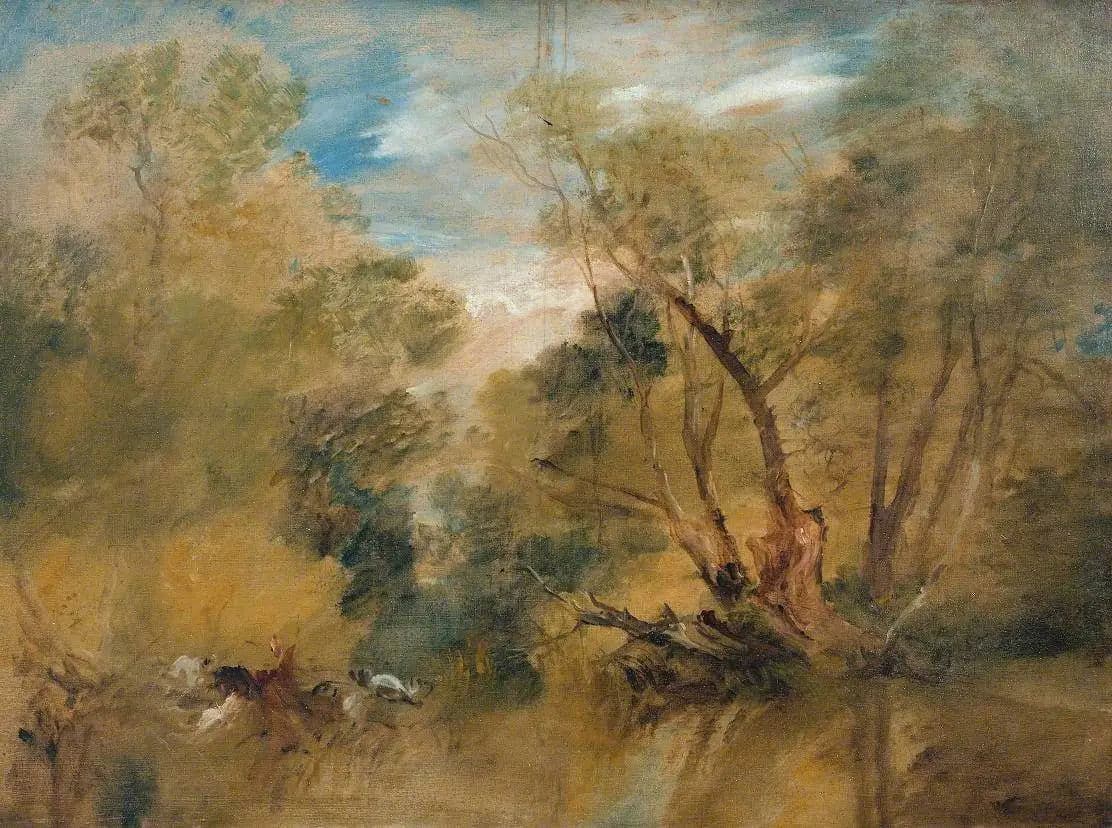
Willows beside a Stream
- Original dimensions
- 86 x 116.2 cm
- Museum
- Tate
- Year
- 1805
Scene depicted
In this pictorial work , Turner invites us to contemplate the peaceful scene where the river gently winds through a lush landscape. The willows, with their delicate foliage, gracefully lean over the water, creating a reflection filled with luminous vibrations. This canvas carries the viewer towards an almost palpable tranquility, inviting escape. The diffuse light, typical of Turner’s style, plays a crucial role in animating this bucolic scene.
Historical context
Created in 1805, this painting is a masterpiece of British romantic art, revealing a Turner at the height of his talent. The painting, which is currently at the Tate museum in London, depicts a serene view along a stream, where light plays among the branches of the willows. The year of creation is faithful to the birth of the romantic movement, this canvas illustrates Turner’s deep connection with nature.
Place in the artist's career
“Willows beside a Stream” represents a pivotal period in Turner’s career, marking the transition to a more emotional and expressive style. Alongside works like “The Fighting Temeraire” and “Rain, Steam and Speed,” this painting highlights his evolution towards exploring atmospheric effects and vibrant lights, placing Turner at the pinnacle of romantic art.
Anecdote
“I paint what I feel more than what I see,” Turner is said to have remarked during the execution of his masterpiece . Inspired by an April morning, he allowed himself to be captivated by the symphony of colors offered by this tranquil landscape. The pure emotion felt that day transforms, through the magic of the brush, into a painting that touches the soul.