Willows at Sunset
Scene depicted
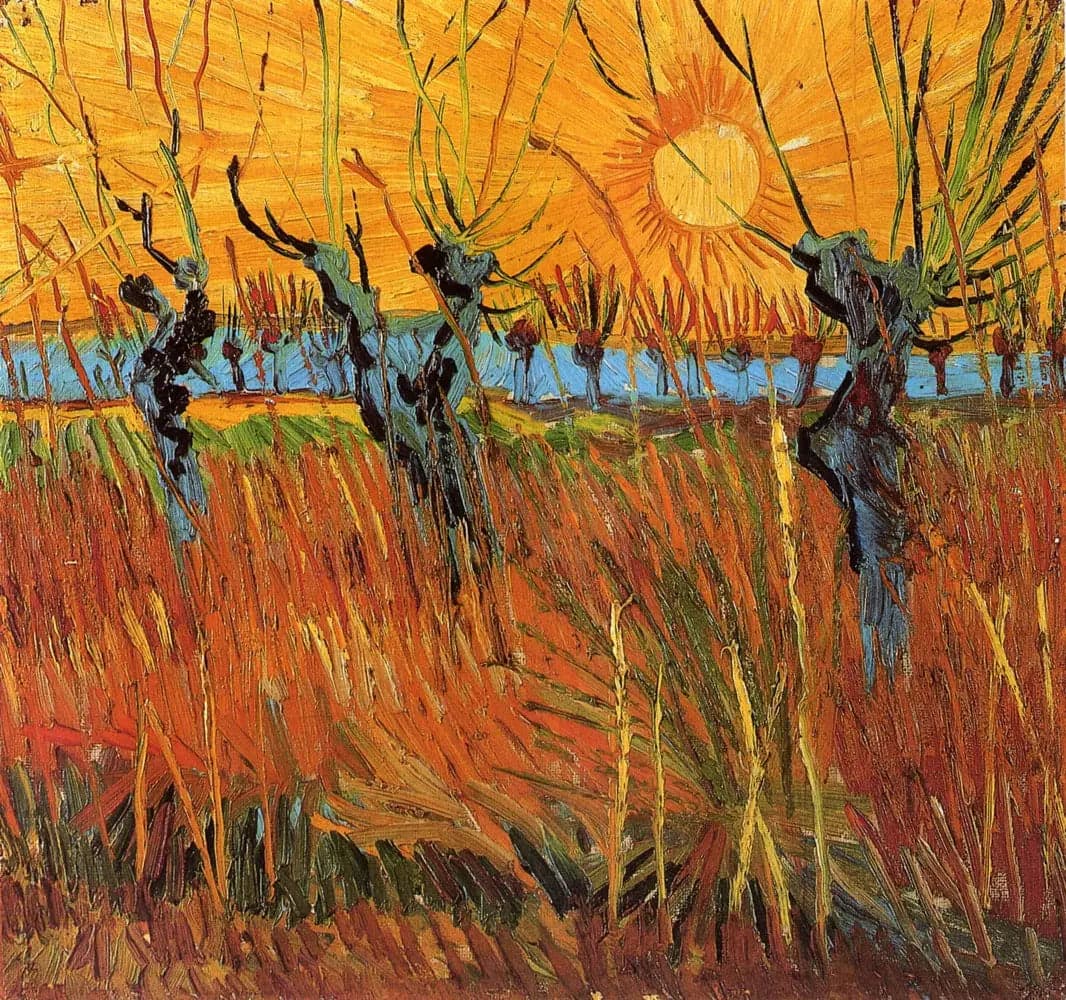
The painting “Willows at Sunset” illustrates a privileged moment, when nature adorns itself in its most beautiful golden and orange hues, at the precise moment the sun disappears on the horizon. Van Gogh, with his palette vibrating with emotions, reveals a delicate scene where the willows, majestic and enveloping, seem to dance under the gentle rays of the setting sun.
Historical context
Created in 1888 in the beautiful city of Arles , this painting is emblematic of the post-impressionist movement, a time when art underwent a bold transformation. Willows at Sunset , currently exhibited at the Kröller-Müller Museum , is a canvas of modest size, measuring 34.5 x 31.5 cm, yet it unfolds a world of emotions through its hues.
Place in the artist's career
This painting marks a pivotal period in Van Gogh's career, reflecting his search for an artistic identity. Compared to other works like “ The Starry Night ” and “ Café Terrace at Night ”, a marked evolution towards a bolder use of color and light can be observed.
Anecdote
“I found a rare light here in Arles , a light that dances on my canvases.” These words from Vincent van Gogh still resonate, evoking the stunning landscapes that surrounded him. One summer evening, while observing the willows by a river, he captures the very essence of this fleeting moment, captivated by the beauty of the sunset reflecting in their graceful branches, transforming the ordinary into a masterpiece .