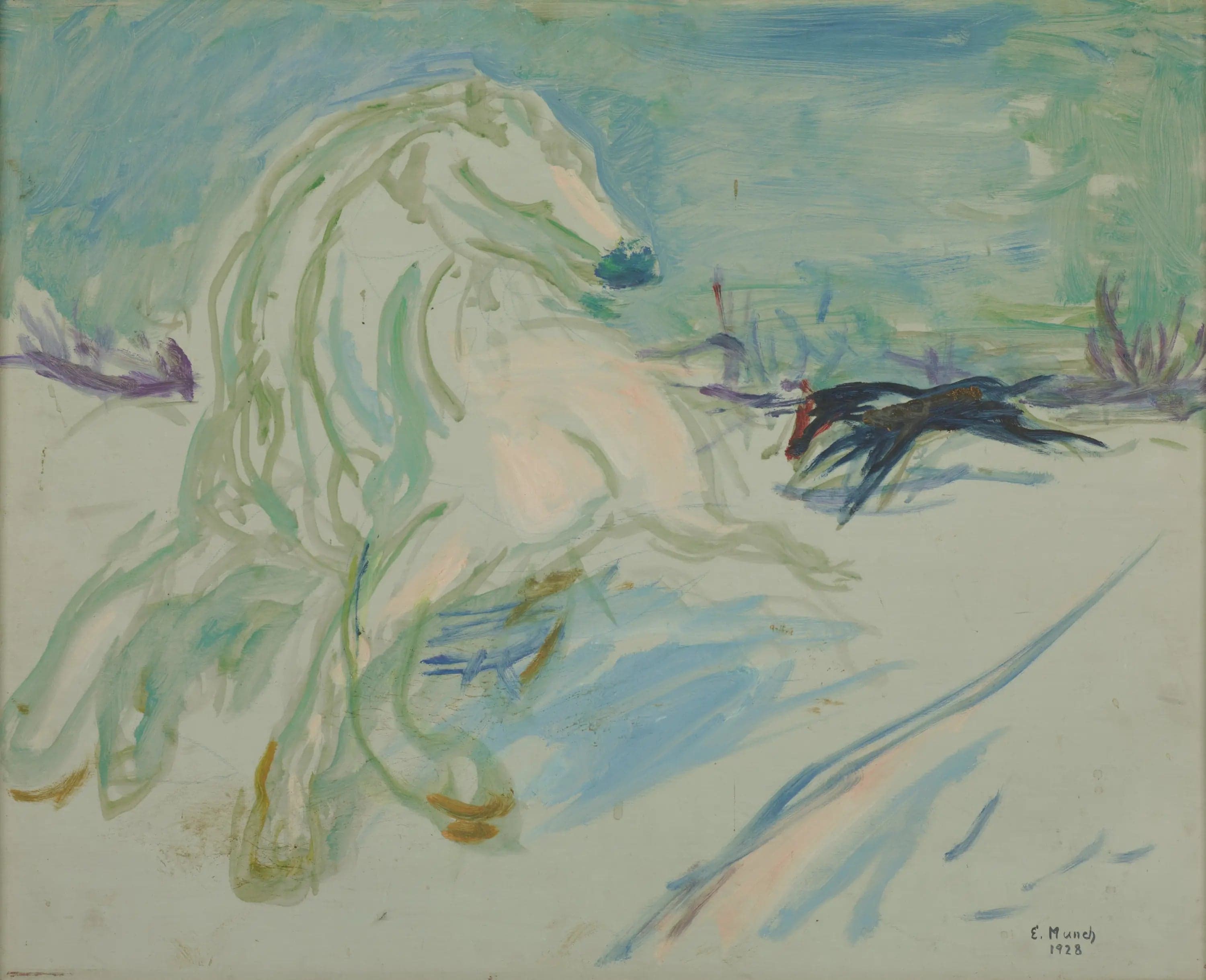
White Horse at Gallop
- Original dimensions
- 61 x 49.5 cm
- Museum
- Munch Museum
- Year
- 1928
Scene depicted
White Horse at Gallop captures the majestic moment of a noble steed cutting through the skies, a symbol of energy and freedom. This painting evokes a snapshot of life, where light slips behind the fluid movements of a powerful animal, offering a striking view of the relationship between man and nature. The composition is both intense and soothing, a dance between strength and grace that transcends the simple frame of the painting .
Historical context
Created in 1928 in Oslo, this painting is an emblematic reflection of an artist seeking to express the depths of the human soul. Edvard Munch , a pioneer of the expressionist movement, transposes here an equestrian movement that resonates with the raw energy of nature. Today, the canvas is housed in the Munch Museum, preserved in a city rich in its artistic history.
Place in the artist's career
This painting represents the peak of Munch's creativity in the 1920s, a pivotal period where he refined his unique style. Like 'The Scream' and 'The Madonna', White Horse at Gallop testifies to an evolution where color and form express purely human emotions, giving the work an unparalleled intensity.
Anecdote
“Nature is my greatest inspiration.” These words from Edvard Munch evoke the spirit of the creator who left his indelible mark on this masterpiece . The work came to life during a morning walk, in the heart of a spring where the fresh air seemed to vibrate under the hooves of galloping horses. It is this visceral connection to the present moment that infuses the canvas with life.