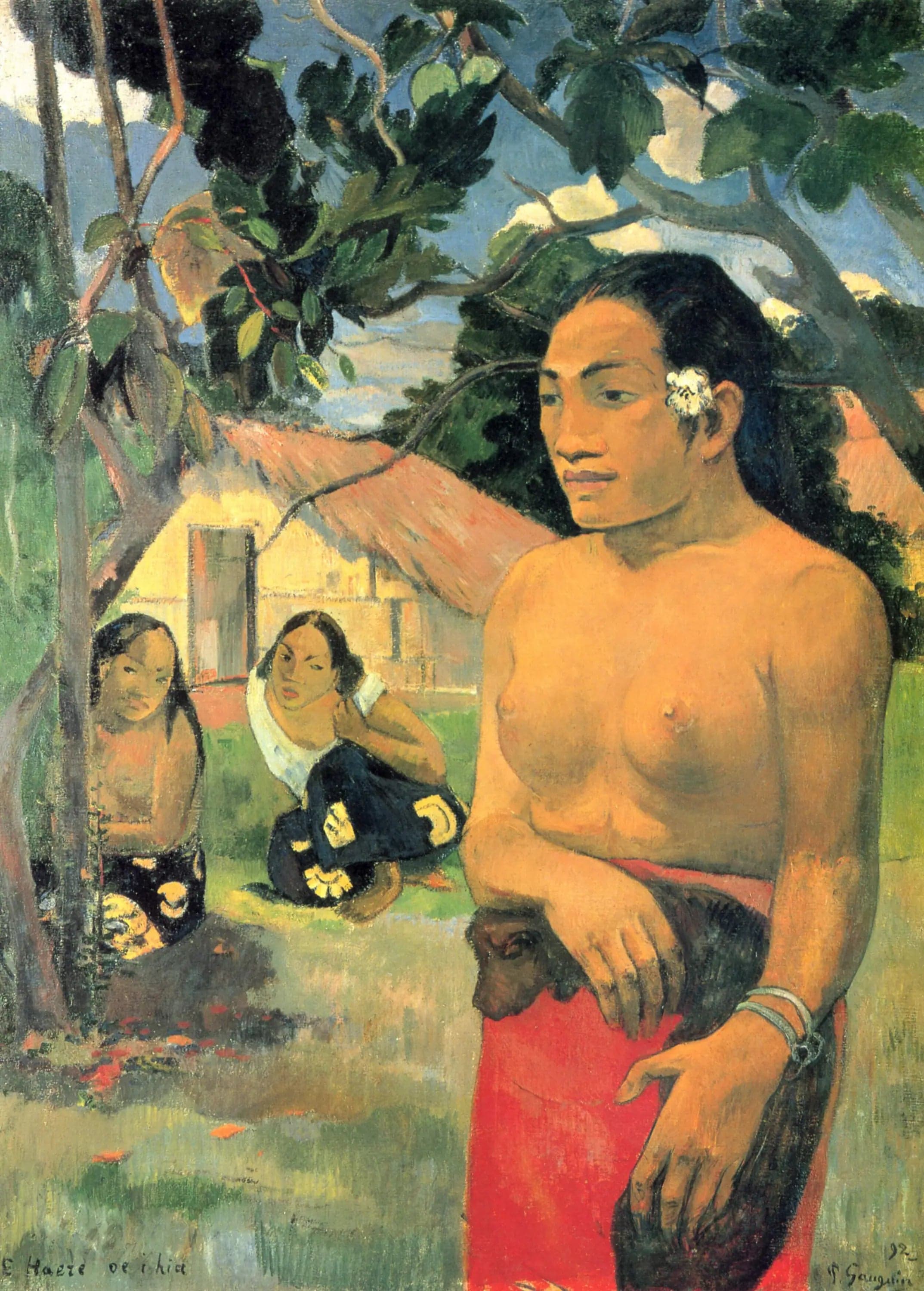
Where Are You Going?
- Original dimensions
- 69 x 96 cm
- Museum
- Staatsgalerie Stuttgart
- Year
- 1892
Scene depicted
“E haere oe i hia” depicts a moment of inner contemplation and a call to nature. The human figures harmonize with the vibrant landscape, transcendent, as if they are dancing with light and shadow. The work invites us to share a moment of spiritual connection, where each brushstroke takes us on a journey through a world that is both real and dreamlike, an invitation to reflection that is at the heart of Gauguin's genius.
Historical context
Created in 1892, the painting “E haere oe i hia” is one of the jewels of the post-impressionist movement, where Paul Gauguin , in search of spirituality, drew his inspiration during his travels in French Polynesia. This pivotal period of modern art, marked by the quest for pure color and uncompromising expression, is reflected in this canvas emblematic. Now exhibited at the Staatsgalerie in Stuttgart, this work measuring 69 x 96 cm stands as a timeless masterpiece that questions our perceptions and emotions.
Place in the artist's career
In Gauguin's career, “E haere oe i hia” manifests as a crucial turning point. This canvas represents the shift towards a more symbolic and refined approach to art. In comparison, earlier works like “Vision after the sermon” and “The cry of the people” show an exploration of narrative through more dramatic emotions, while this painting establishes a surreal language based on color and composition.
Anecdote
Gauguin, with a vibrant passion for his artistic vision, said: “Painting is an anchor in eternity.” This phrase resonates particularly when he recalls the moment when the idea of “E haere oe i hia” emerged, sweeping across a turquoise sea, to the sound of waves singing the secrets of tropical nature. This call of wild beauty becomes an integral part of his masterpiece , merging raw emotion with refined technique.