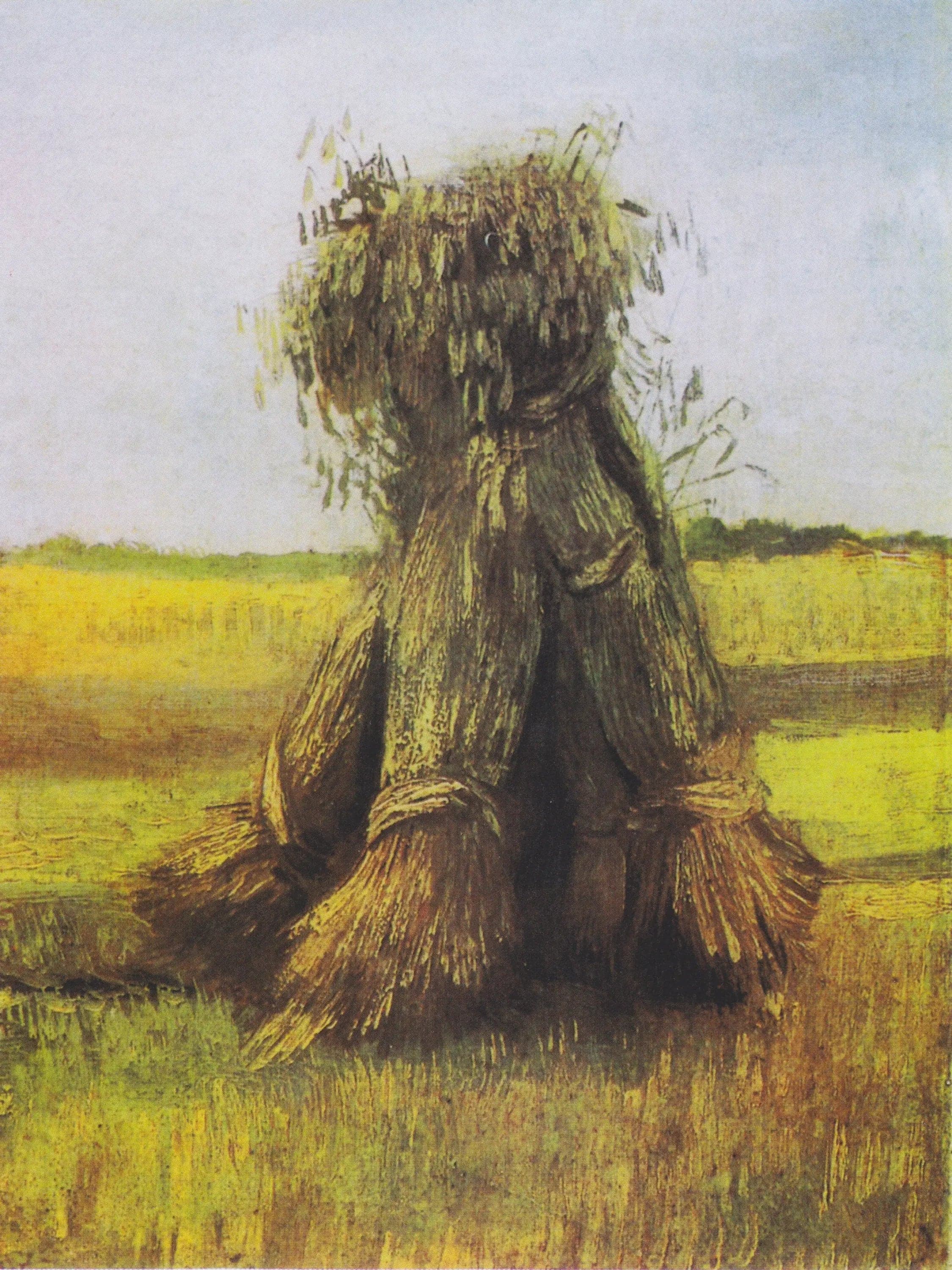
Wheat Sheaves in a Field
Scene depicted
This painting highlights the vibrant beauty of the wheat fields, capturing a moment where nature flourishes. At the heart of this composition, the wheat sheaves stand as offerings to the light, revealing a harmony between humanity and the rural landscape. The golden hues, animated by the breeze, offer a living tableau and breathe the authenticity of the earth.
Historical context
Created in 1885, this painting is iconic and comes from Nuenen , Netherlands. This painting is part of the post-impressionist movement, a period during which Vincent van Gogh matured his unique style. Currently, this painting is preserved at the Kröller-Müller Museum . Its dimensions, measuring 30 x 40 cm, testify to the intimacy of this work.
Place in the artist's career
Positioning Wheat Sheaves in a Field as a pivotal work in Van Gogh's career, this painting reveals his emotional commitment to nature. Alongside it, works such as The Starry Night and Flowers in a Vase demonstrate the evolution of his style, moving from an objective representation to an inner exploration of colors and lights.
Anecdote
“I wanted to immortalize the beauty of the wheat fields, rich with hope and life,” Van Gogh might have said, inspired by a spring morning, where the wind danced over the golden ears. This deep emotion resonates through every brushstroke of Wheat Sheaves in a Field .