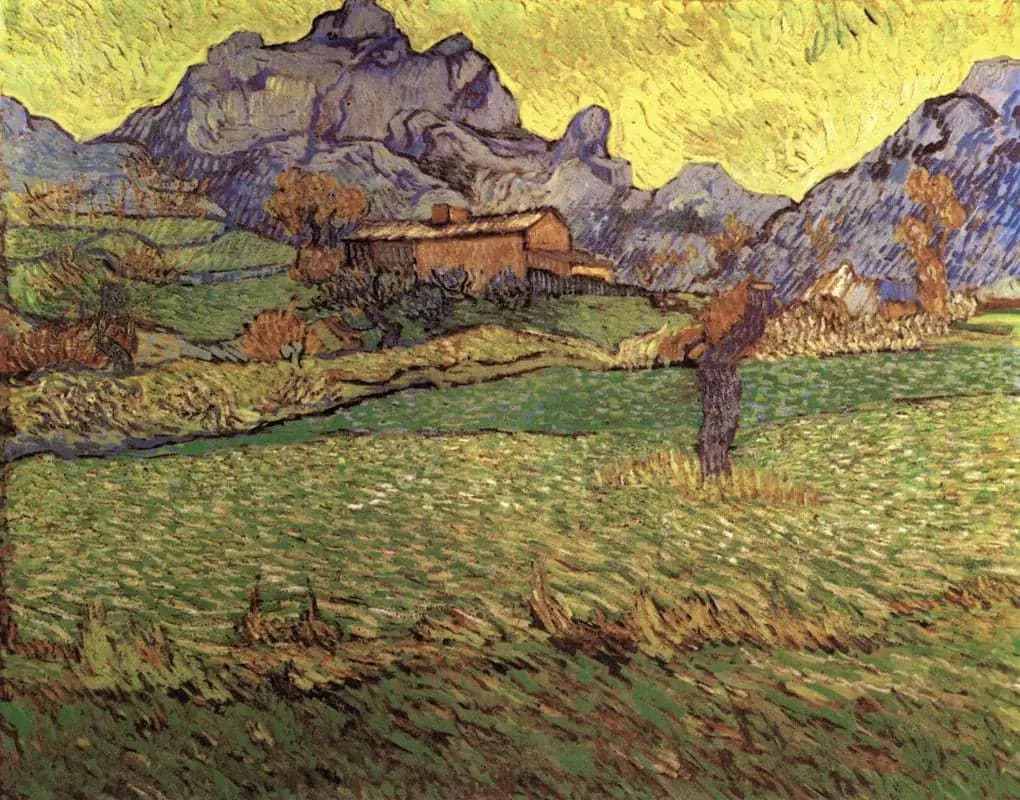
Wheat Fields in a Mountain Landscape
Scene depicted
The composition of Wheat Fields in a Mountain Landscape reveals a landscape vibrant, where golden fields stretch as far as the eye can see, bordered by imposing mountains. In this pictorial work, the sky mingles with the undulating wheat, illuminated by a light of emotional intensity, transporting the viewer on a journey through van Gogh's singular vision.
Historical context
This painting , titled Wheat Fields in a Mountain Landscape , was created in 1889 in the picturesque town of Saint-Rémy-de-Provence , a magnificent French region conducive to inspiration. This painting is part of the Post-Impressionism , a bold artistic movement that flourished at the end of the 19th century. Currently, this exceptional painting is located at the Kröller-Müller Museum , where it enchants visitors with its dimensions of 91.5 x 73 cm.
Place in the artist's career
This painting represents a key moment in the career of Vincent van Gogh , illustrating both his artistic maturity and his thirst for new experiences. By comparing it to The Starry Night and The Sunflowers , we can observe his technical and emotional evolution, where color and texture become major elements of his pictorial language.
Anecdote
Vincent van Gogh himself said: "I dream of painting, and then I paint my dreams." This quote evokes the magic of a spring morning when the artist's talent was stimulated by the wild beauty of nature, advising him to immortalize these sunny fields, their ears dancing in the wind. The painting thus becomes a powerful testimony of his love for nature.