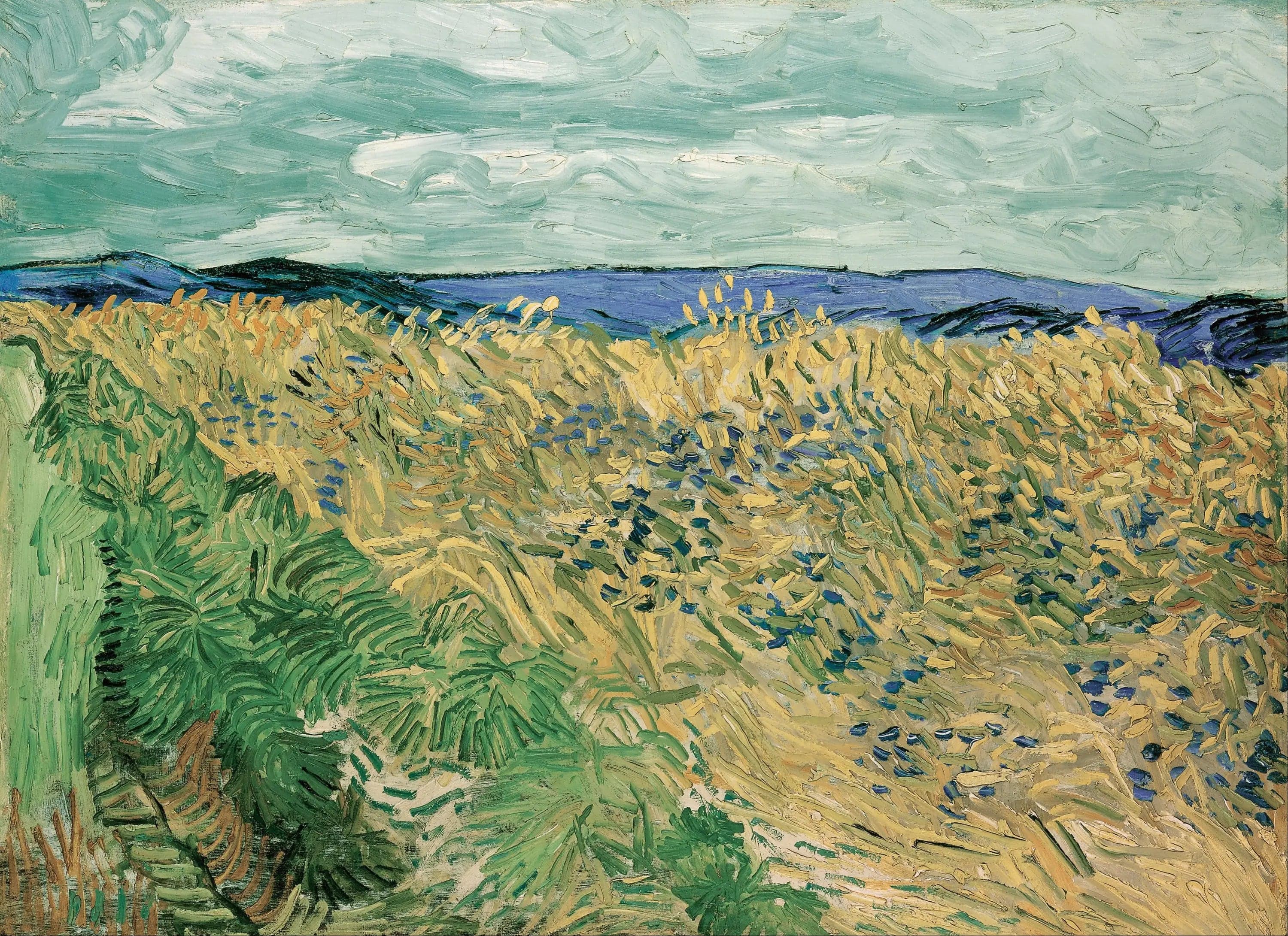
Wheat Field with Cornflowers
Scene depicted
This canvas evokes a pastoral scene where the wheat fields stretch as far as the eye can see, dotted with vibrant crows. Van Gogh's pictorial work presents a tension between the softness of the flowers and the vigor of the ears, reflecting a nature that is both peaceful and wild. It embodies the artist's concerns for the rural world while giving it an almost spiritual dimension.
Historical context
Created in 1890, the painting Wheat Field with Crows is set in the artistic context of post-impressionism . This masterpiece was developed in Auvers-sur-Oise , a French commune rich in artistic history, which has seen the birth of many creative visions. Today, the canvas is preserved at the Beyeler Foundation . With dimensions of 81 x 60 cm, this canvas still resonates with the energy of its time.
Place in the artist's career
The painting Wheat Field with Crows is situated at a poignant turning point in Van Gogh's career, known for his chromatic and emotional explorations. In his journey, this work aligns with paintings such as The Sunflowers and The Starry Night , marking an evolution in his use of color and texture, leading him towards unprecedented maturity.
Anecdote
Vincent van Gogh once whispered: “Nature is everything. I only need a blade of wheat to read the beauty of the world.” Inspired by a spring morning in the wheat fields, he captured this essence in his painting , a fleeting moment that transcended time, anchoring Wheat Field with Crows in our collective memory.