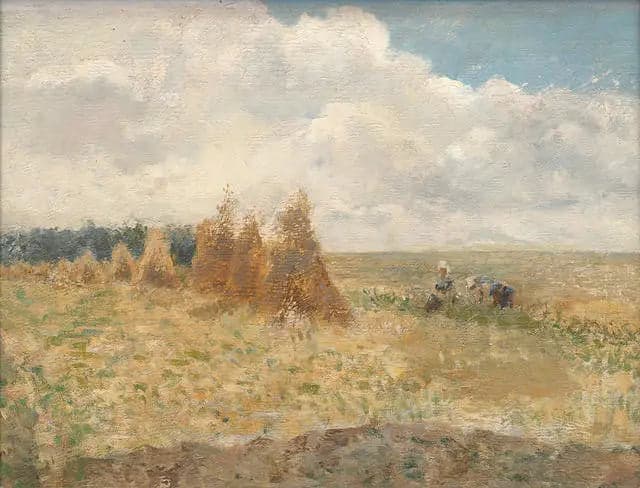
Wheat Field
- Original dimensions
- 56.5 x 48 cm
- Museum
- Christchurch Art Gallery
- Year
- 1880
Scene depicted
In this pictorial work, the gaze is immediately drawn to a golden wheat field stretching as far as the eye can see. The ears dance in the wind under a blue sky, bringing a sense of serenity. The light plays with the shadows, illustrating a precious moment between day and night, which Boudin brilliantly captured in this evocative composition.
Historical context
Created in 1880, this iconic work by Eugène Boudin is set in the vibrant context of Normandy, where the painting was born. Illustrating the Impressionist movement, Wheat Field reflects an era marked by a quest for light and landscapes. The painting , currently housed at the Christchurch Art Gallery, is an ode to the beauty of the Norman fields, with dimensions of 56.5 x 48 cm inviting escape.
Place in the artist's career
Wheat Field represents a turning point in Boudin's career, showcasing his mastery. While he had already gained recognition with works such as The Port of Honfleur and The Beaches of Trouville , this painting demonstrates his refinement and willingness to explore new artistic horizons. His style, already mature, reveals a vibrant palette and a refined technique.
Anecdote
Eugène Boudin once confessed: "Nature never betrays us; it is the mother and guide of all our creative impulses." Inspired by a gentle spring morning, he painted tirelessly to capture the very essence of the land. This feeling of escape is at the heart of Wheat Field , where each brushstroke conveys a breath of fresh air and the scent of freshly plowed earth.