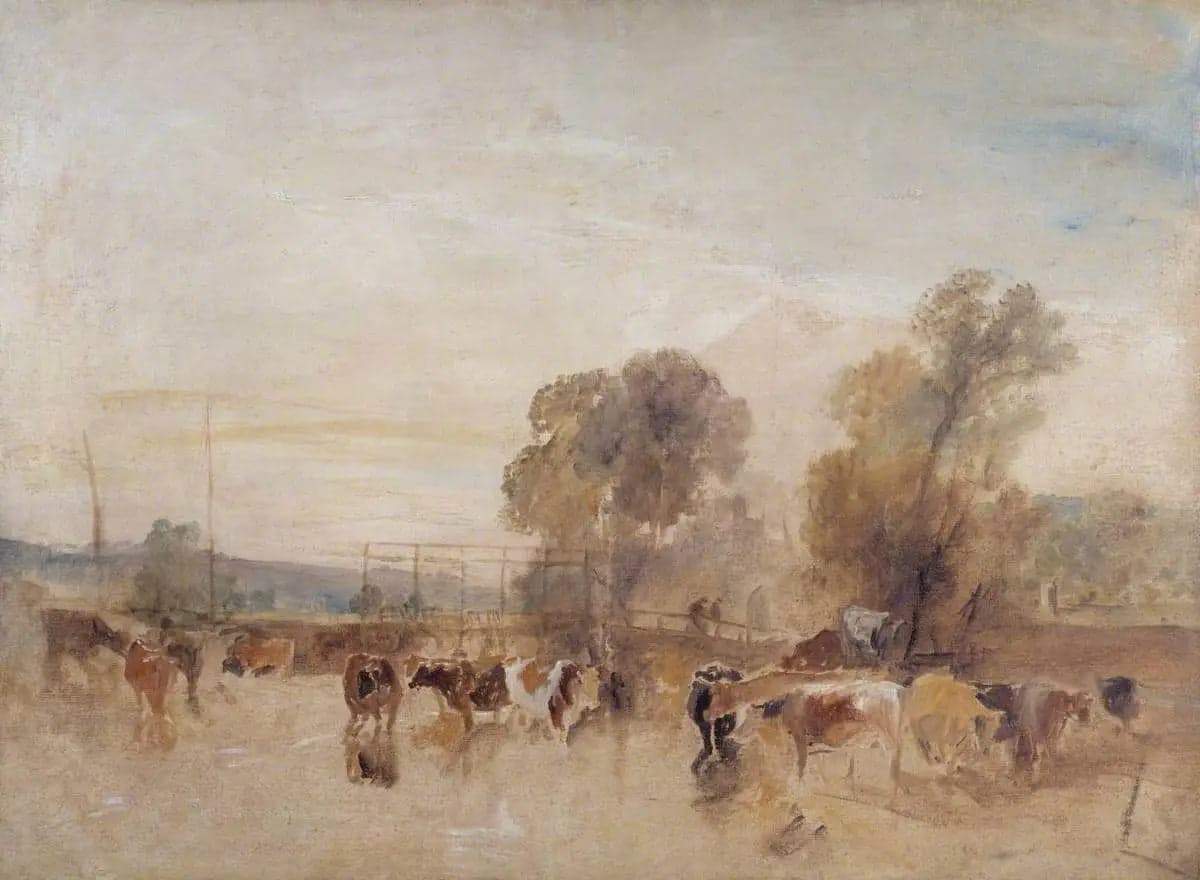
Weir and Cattle
- Original dimensions
- 88.3 x 120 cm
- Museum
- Tate
- Year
- 1806
Scene depicted
The canvas “Weir and Cattle - J. M. W. Turner” immerses us in a peaceful rural landscape, where cattle delight in the lush grasses by the water's edge. Turner uses dynamic brushstrokes to render the vital interaction between light and shadow, giving an almost living impression to this bucolic scene. This painting evokes a powerful nostalgia and a sense of escape into a serene world.
Historical context
Created in 1806 in the city of London, Weir and Cattle beautifully illustrates the romantic era, an artistic movement imbued with passion and sensitivity. This painting, now housed at the Tate , depicts a bucolic scene that evokes the harmonious relationship between man and nature, while capturing the light of a fleeting moment. The imposing dimensions of this work, 88.3 x 120 cm, give it a captivating presence.
Place in the artist's career
Weir and Cattle represents a pivotal period in Turner's career, where he refines his style and use of light. Compared to works such as The Fighting Temeraire or The Light of the World , this painting demonstrates his artistic evolution towards poetic abstraction, while still being, in his early days, rooted in the tangible reality of British landscapes.
Anecdote
“Light is the color of my emotions,” Turner is said to have declared. One sunny morning, as the artist walked by a river, he was inspired by the shimmering reflections in the water and the silhouettes of cattle peacefully gathered. This creative moment materialized in Weir and Cattle , a canvas that captures the very essence of his love for nature.