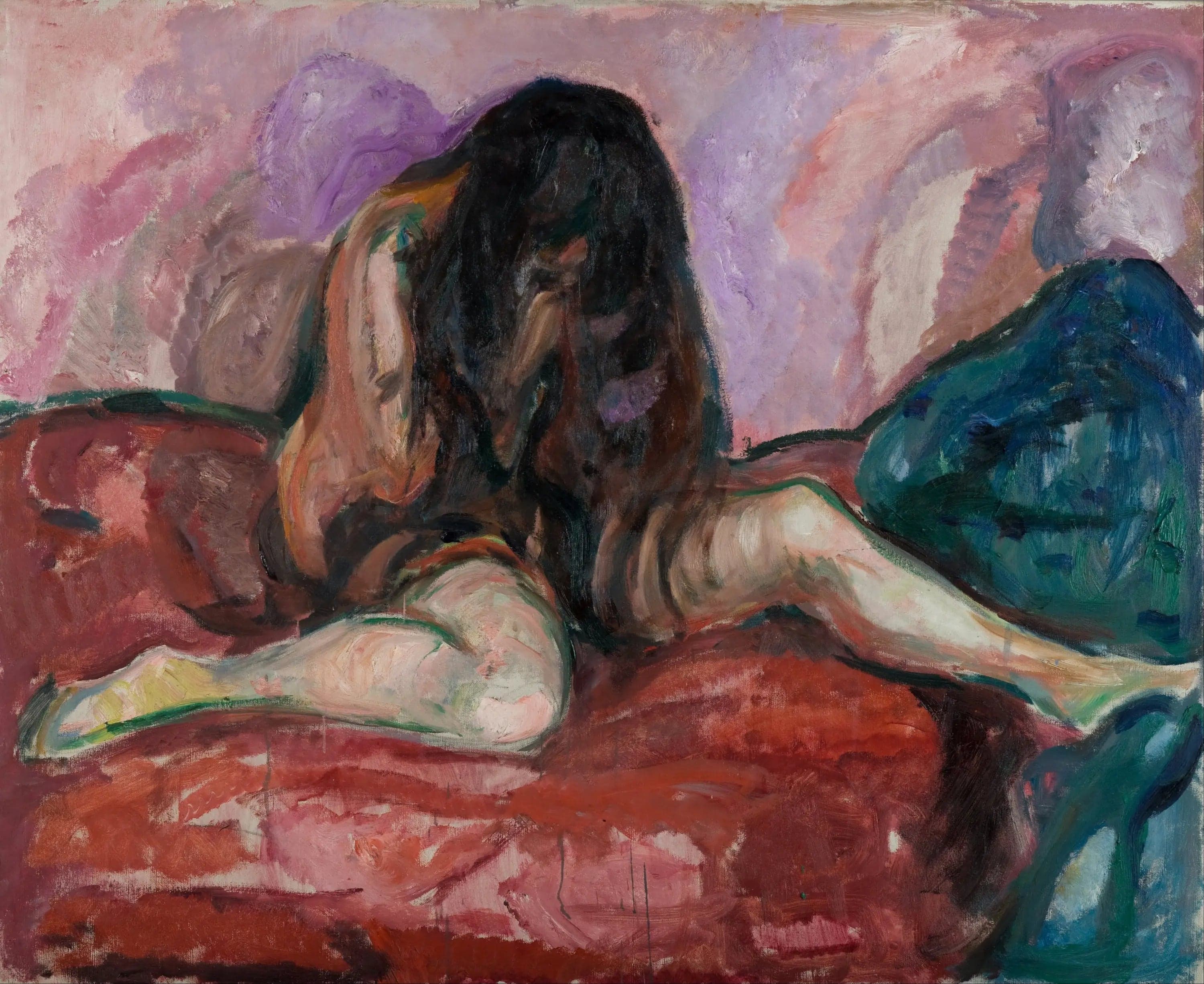
Weeping Nude
- Original dimensions
- 120.7 x 100.3 cm
- Museum
- Museum of Fine Arts Houston
- Year
- 1919
Scene depicted
In the painting "Weeping Nude", Munch explores the fragility of the human soul. This canvas represents a female figure, engulfed in deep melancholy, posed in the foreground. The background, swirling with dark colors, accentuates the intensity of the emotion, creating an atmosphere laden with sadness and despair. Each brushstroke reveals a silent scream, a quest for comfort, plunging the viewer into the inner turmoil of the protagonist.
Historical context
Created in Oslo, this painting is iconic and dates back to 1919. It emanates from the expressionist movement, a current that marked its time by its desire to express intense human emotions. The canvas is now displayed at the Museum of Fine Arts Houston, where it continues to captivate the gaze of visitors. Its dimensions of 120.7 x 100.3 cm make it an imposing and striking artwork .
Place in the artist's career
This canvas hints at a pivotal phase in Munch's career, marking a stylistic peak. Compared to other works like 'The Scream' and 'Madonna', 'Weeping Nude' illustrates the evolution of the treatment of the human psyche, moving away from more realistic forms to embrace expressionism in its pure and raw form.
Anecdote
Munch, one spring day in his hometown, exclaimed: "Art does not reproduce the visible; it makes visible what is not always apparent." This quote resonates deeply in connection with the painting we discover here. The masterpiece , 'Weeping Nude', was inspired by a poignant encounter, where every emotion, every tear, was transcribed with passion.
Major exhibitions
Edvard Munch and his models: 1912-1943