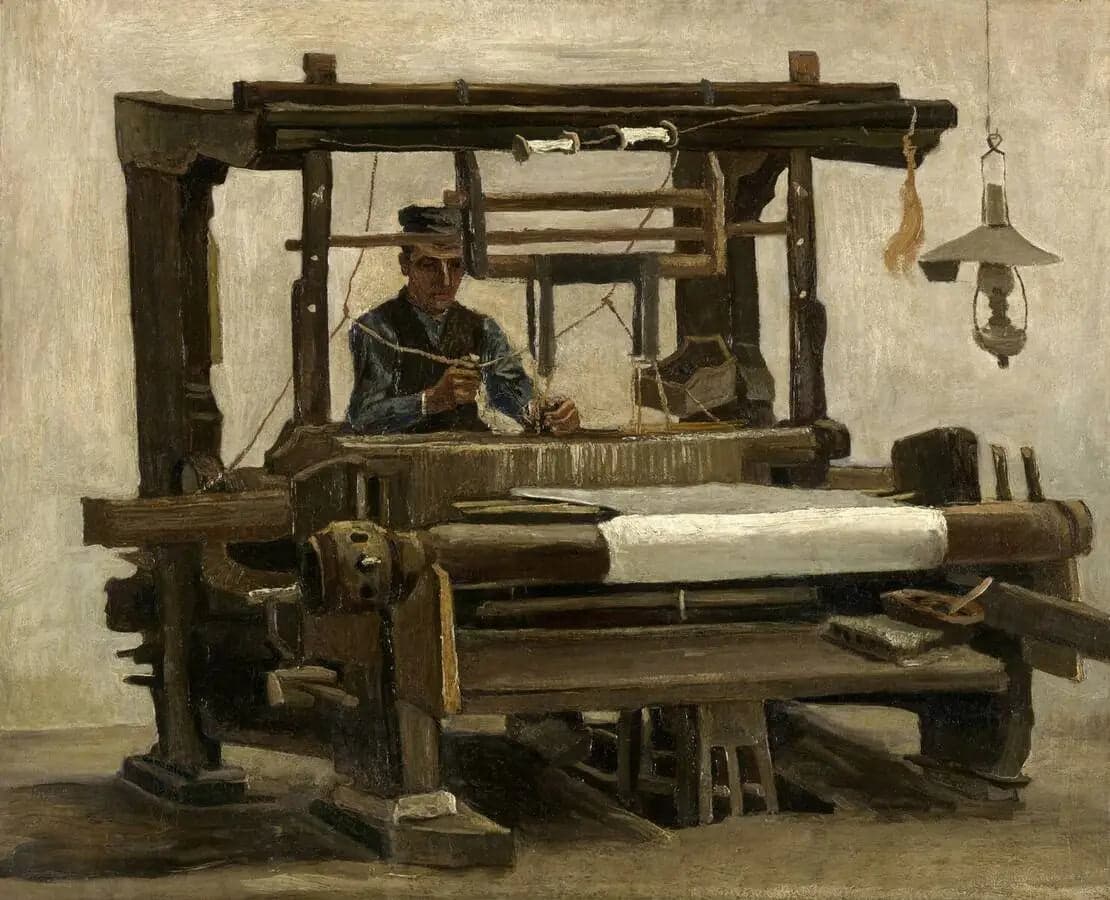
Weaver at the Loom
Scene depicted
The painting “Weaver at the Loom” meticulously depicts an artisan absorbed in his work. In a muted atmosphere, each gesture conveys dedication and passion, while the threads intertwine, weaving both a material and a connection between man and his environment. The soft light illuminates the scene, highlighting the textures of the materials and the concentration of the weaver, thus creating a vital connection between the worker and his art.
Historical context
Created in 1884, this painting comes to life in Nuenen , Netherlands, as part of the post-impressionist movement. At a time when Vincent van Gogh explores the daily life of peasants and artisans, this canvas fits into a period of deep engagement with socio-cultural themes. Currently, the painting is housed at the Kröller-Müller Museum , where its dimensions of 85 x 70 cm invite intimate contemplation.
Place in the artist's career
This painting represents a pivotal phase in Van Gogh's career, where he begins to develop his signature style. Alongside other works such as “ The Potato Eaters ” and “ The Asylum Garden ”, “Weaver at the Loom” reflects the evolution of his technique and his ability to capture the essence of peasant life, while foreshadowing his future commitment to expressionism.
Anecdote
“Beauty lies in the effort of daily work.” These words, though never spoken directly, resonate as an invitation to feel the magic of the simple life surrounding this work. That morning, as the first rays of sunlight made their way through the dusty windows of the studio, Van Gogh found inspiration in the repetitive pattern of weaving, a silent dance of colors and shapes that awakens the emotion of the painting .