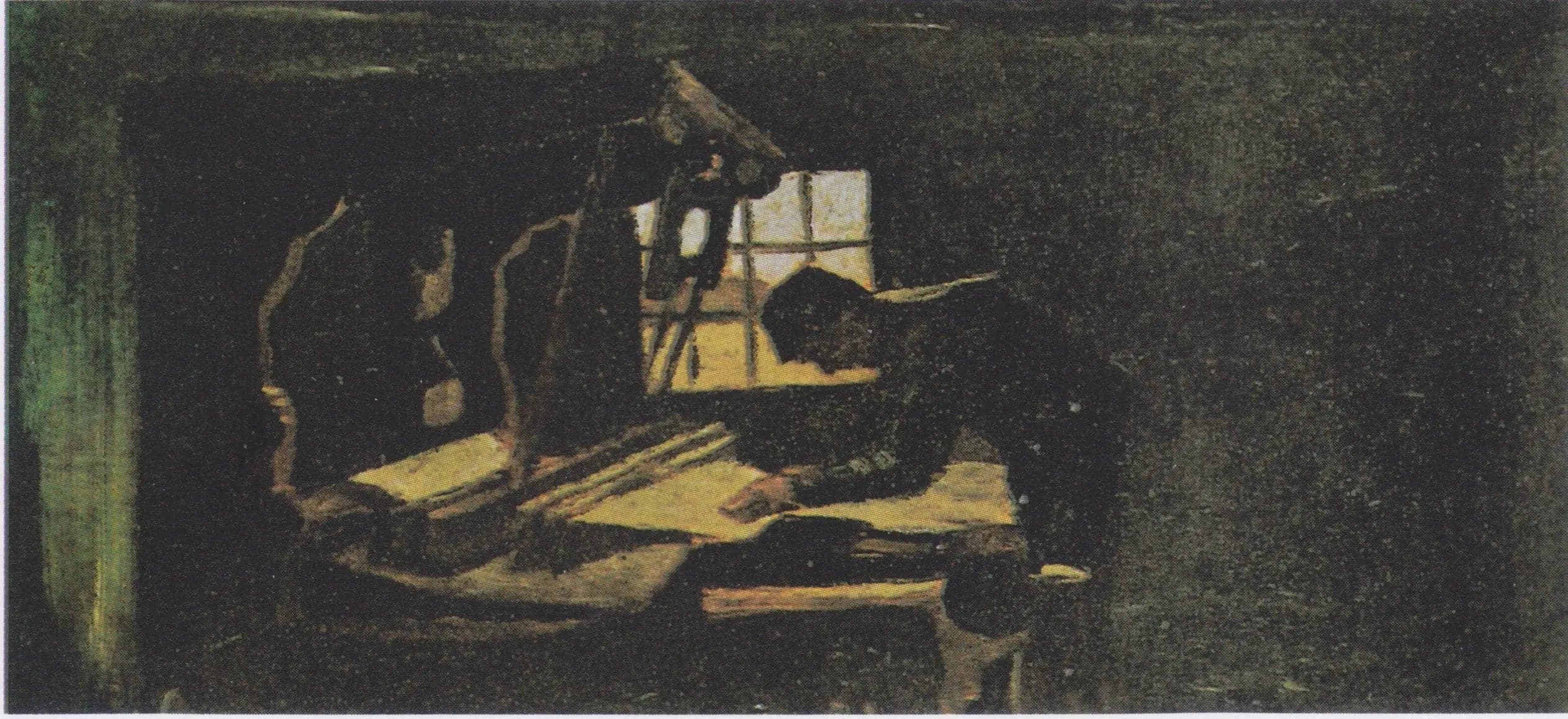
Weaver arranging the threads
- Original dimensions
- 41 x 19 cm
- Movement
- realism
- Museum
- Not specified
- Year
- 1884
Scene depicted
The scene of the painting reveals a weaver busy delicately organizing his colorful threads, a daily task that, under Van Gogh's brush, transforms into a visual ballet. Each filament and each shadow evoke not only manual labor but also a deep connection between man and his tools. The rough textures of the painting add a tactile dimension, allowing the viewer to almost feel the vibrant materials of the thread that create complex patterns.
Historical context
Created in 1884, the painting titled Weaver Arranging Threads is the result of a time when Vincent van Gogh , still deeply exploring his art, sought to capture the beauty of everyday life in the historic town of Nuenen , in the Netherlands. This painting, a powerful example of the realistic movement, reflects a moment where nature and craftsmanship intertwine, immersing the viewer in a typically Dutch atmosphere of soft light and calm.
Place in the artist's career
This painting , occupying a significant place in Van Gogh's career, represents a phase of maturity and stylistic discovery. It can be paralleled with The Potato Eaters and Starry Night , two other iconic paintings that reveal the artist's evolution towards a more expressive representation of his emotions and human nature.
Anecdote
“Art is the reflection of life in all its simplicity,” Van Gogh might have said, as he observed a weaver at dawn, the threads in his hands. This moment, carefully captured in the canvas , invites us to feel the rhythm of rural life, the melody of daily labor, in an atmosphere imbued with human warmth and creativity.