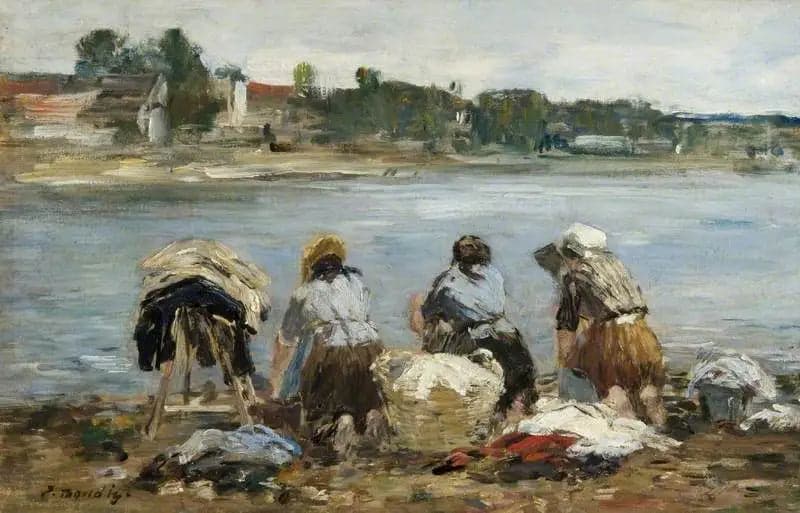
Washerwomen on the Banks of the Touques
- Original dimensions
- 41 x 26.7 cm
- Museum
- National Gallery of Scotland
- Year
- 1894
Scene depicted
“Washerwomen on the Banks of the Touques” testifies to an era marked by work and closeness to nature. The scene depicts women busy washing laundry by the banks of this iconic river, projecting an atmosphere of calm, but also of activity. Through this canvas , Boudin offers us a vibrant composition, filled with warmth and natural light, inviting the observer to soak in the peace of a moment stolen from time.
Historical context
Created in 1894, this painting is set in the charming town of Honfleur, in Normandy, at the heart of an artistic movement that advocates Impressionism . At this time, Boudin captures moments of daily life, celebrating the beauty of nature and people through his works. The canvas is now displayed at the National Gallery of Scotland, where its dimensions of 41 x 26.7 cm reveal dazzling delicacy and detail.
Place in the artist's career
This canvas represents a key milestone in the career of Eugène Boudin , illustrating his penchant for Norman landscapes and the work of men and women. Alongside other works such as “Trouville Beach” and “Luncheon on the Grass,” Boudin shows a technical evolution that will lead him to influence artists like Monet. This masterpiece testifies to his growing expertise in the eloquence of light and the expressionism of human figures.
Anecdote
“I paint what I see and what I love. The washerwomen by the river evoke with every brushstroke, a silent poem under the cloudy sky.” These words could perfectly illustrate the genesis of this masterpiece . In these precious moments, one spring morning, Boudin is inspired by the whisper of the water, the scent of flowers, and the vibrant rhythm of life of the washerwomen.