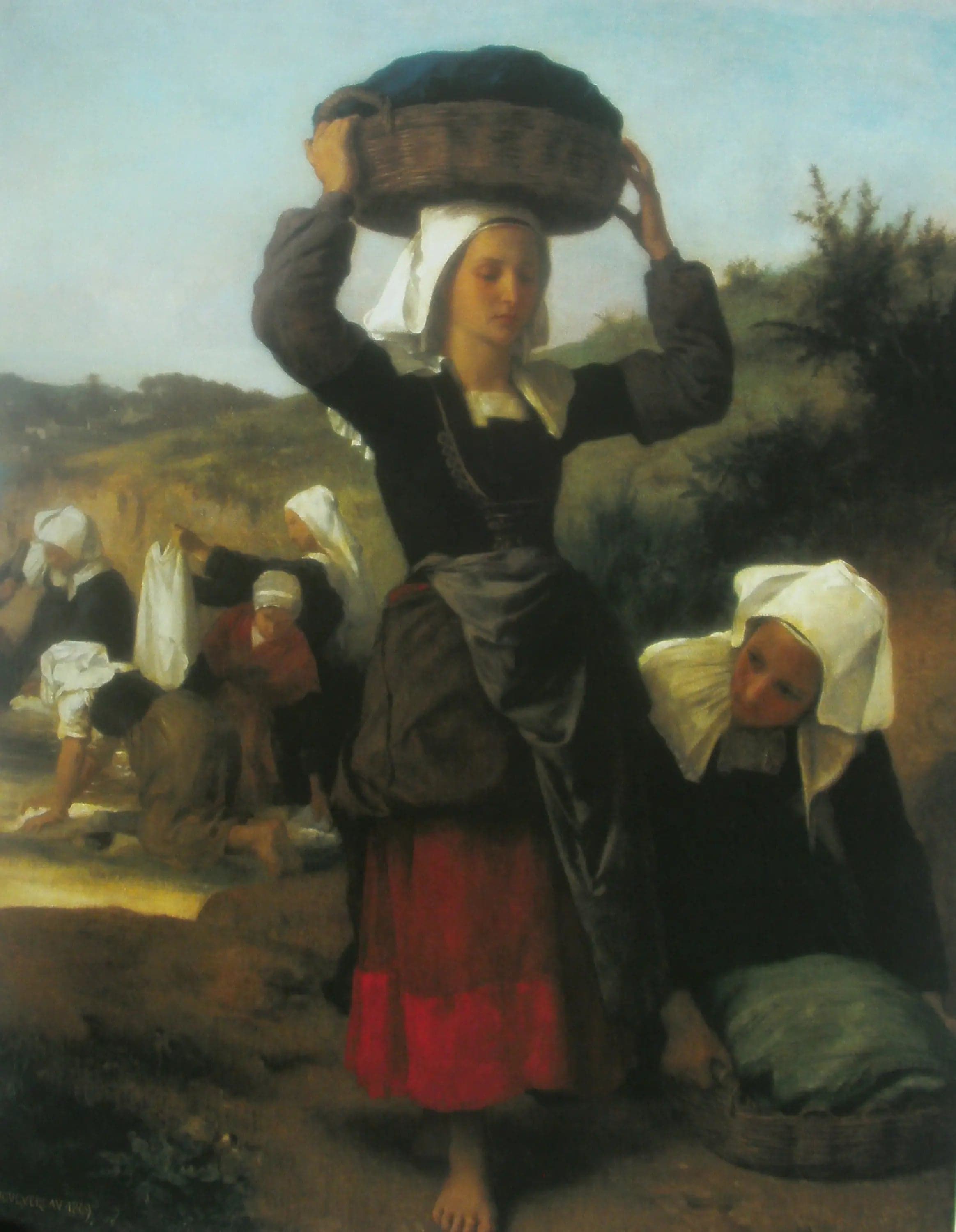
Washerwomen of Fouesnant
- Original dimensions
- 60 x 76.2 cm
- Museum
- Memorial Art Gallery
- Year
- 1869
Scene depicted
At the heart of this canvas , we discover a scene of Breton daily life: women engaged in their duty of washing clothes on the tranquil banks of a river. Their harmonious, almost choreographed movements reveal a routine steeped in tradition and simplicity, as if time had stopped to capture this timeless image. The bucolic atmosphere invites the viewer to dive into a reality imbued with freshness and serenity.
Historical context
Created in 1869, the painting "Lavandières de Fouesnant" is part of the French academic movement, at a time when realism and impressionism began to emerge. This iconic canvas comes from a region with picturesque landscapes, Fouesnant, a place rich in history and nature, located in Brittany. This masterpiece is currently carefully preserved at the Memorial Art Gallery , where visitors can admire this delicate composition with generous dimensions of 60 x 76.2 cm.
Place in the artist's career
"Lavandières de Fouesnant" represents a significant milestone in Bouguereau's career. At this time, he established himself as one of the leaders of academic art, blending classical techniques with modern sensibility. By comparing it with other works such as "The Youth of Bacchus" and "The Little Fishermen," one can appreciate the evolution of his style, from the softness of the lines to a flourishing complexity.
Anecdote
"Beauty lies in the details of everyday life," said Bouguereau. That morning, as the gentle rays of the Breton sun pierced through the sails of the port, he captured the essence of a peaceful scene, full of life and charm. It was by observing these busy washerwomen that the evocative power of "Lavandières de Fouesnant" was born.