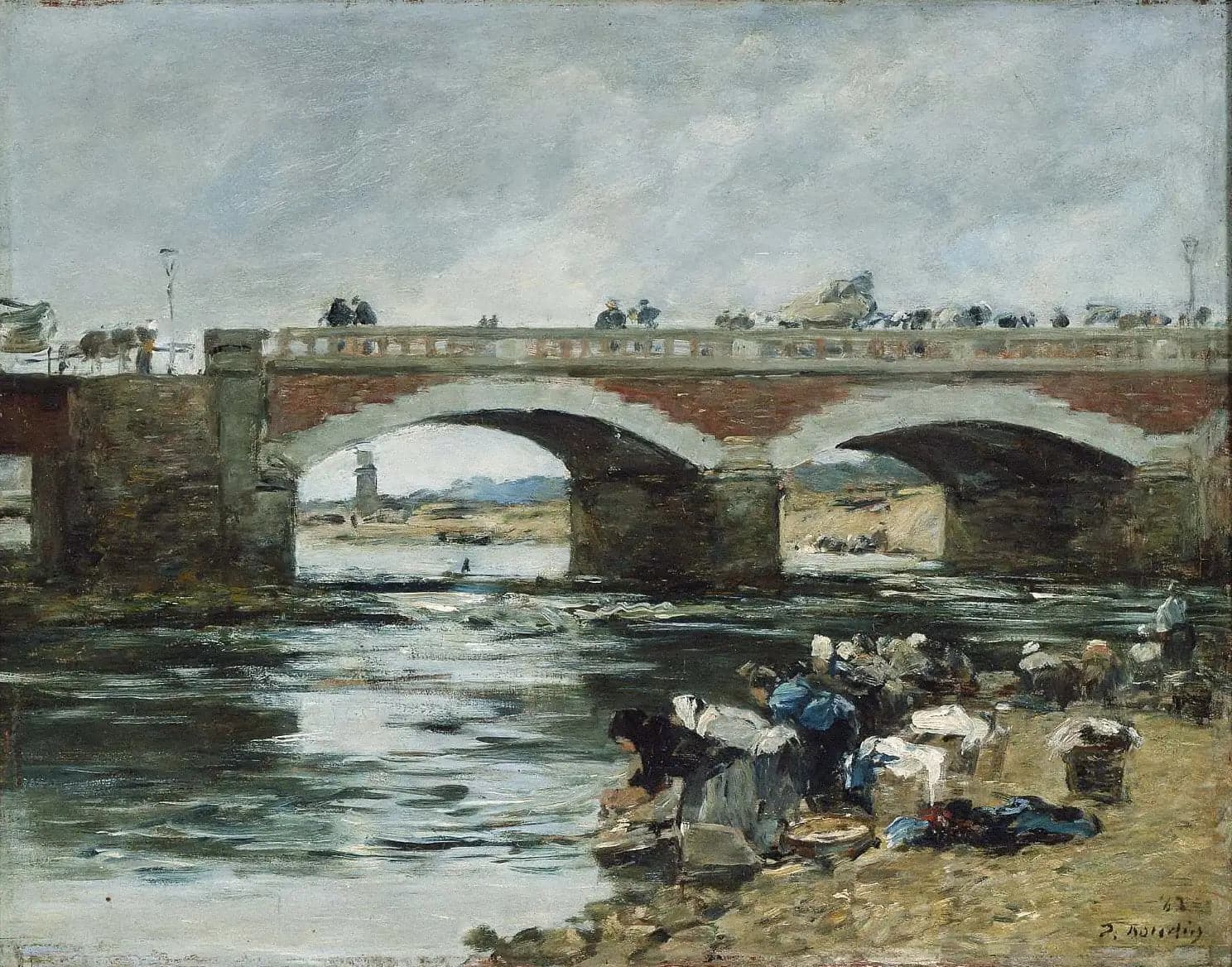
Washerwomen near a bridge
- Original dimensions
- 41 x 32 cm
- Museum
- Museum of Fine Arts Boston
- Year
- 1883
Scene depicted
In this masterpiece, Boudin's art takes shape and life, illustrating a daily scene of washerwomen at work near an elegant bridge. The movements of the women, armed with baskets full of laundry, intertwine with the gentle current of the water, creating a visual dance where each gesture is an ode to the simplicity of rural work and the pleasures of a sunny day. The bright and comforting hues bring warmth and an invitation to observe this moment suspended in time.
Historical context
Created in 1883, the painting "Washerwomen near a Bridge" emanates from an iconic artist of the Impressionist movement, Eugène Boudin . Situated at the crossroads of artistic innovation and pictorial tradition, this canvas was painted in a bucolic setting, capturing the essence of a Norman daily life, like a delicate echo of the sensory experiences that rhythm life by the water. The painting is currently displayed at the Museum of Fine Arts Boston , keeping its brilliance intact over the years.
Place in the artist's career
"Washerwomen near a Bridge" represents a turning point in Boudin's career in search of brilliant light and lively compositions. Between his beginnings filled with classical influences and his ultimate flourishing in Impressionism , one could also mention works such as "Trouville Beach" and "The Port of Honfleur," which testify to his journey, both artistic and emotional.
Anecdote
"Nature is my greatest teacher," Boudin might have said, often evoking the inspiration he found in the landscapes of the countryside. This painting was born on a quiet morning, as the sun caressed the busy washerwomen, and the light breeze carried notes of lavender mixed with the scent of earth nourished by the river's waters.