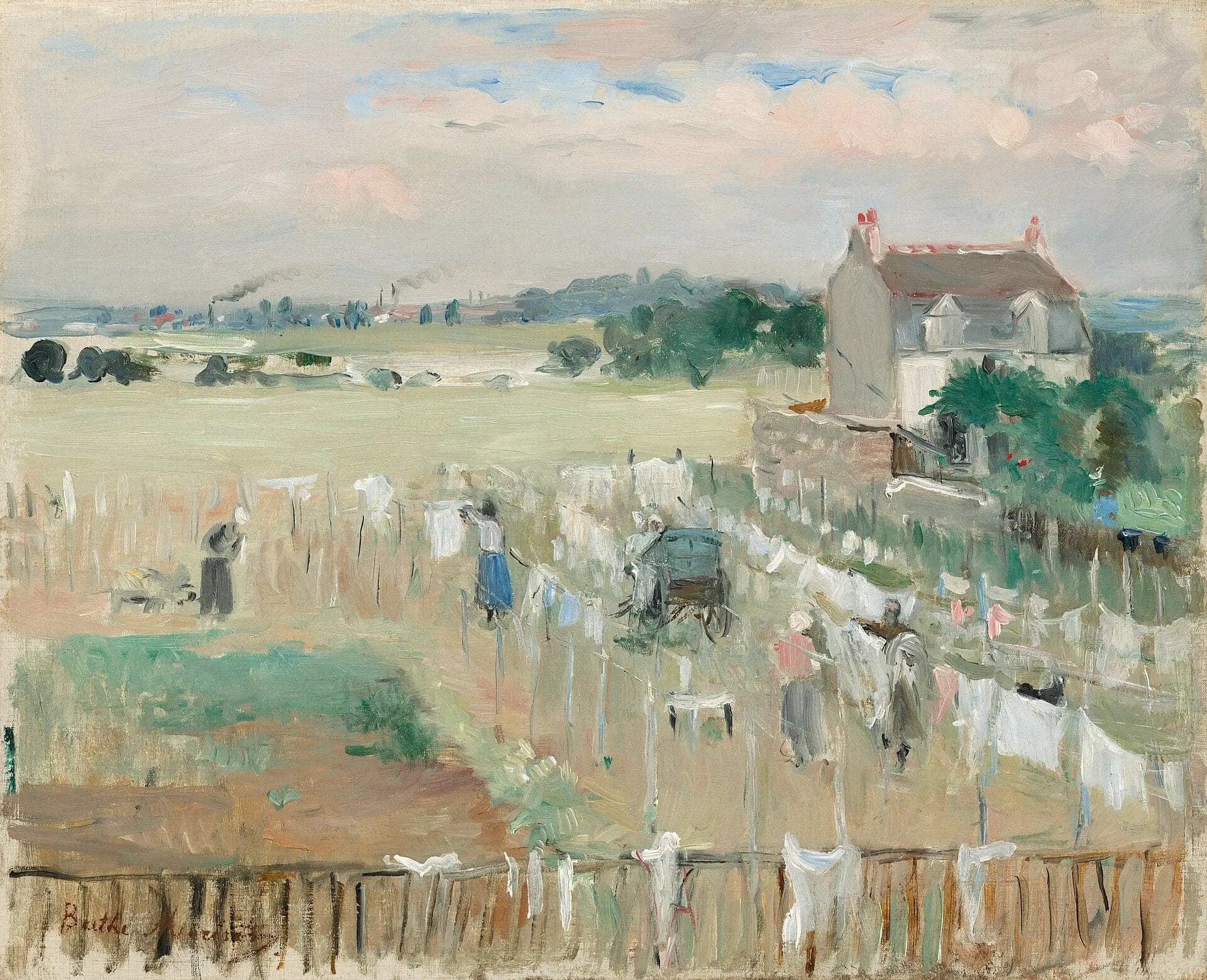
Washerwomen at the Perche
- Original dimensions
- 40.6 x 33 cm
- Museum
- National Gallery of Art
- Year
- 1875
Scene depicted
In this pictorial work , Morisot immortalizes the lively and light-filled scene of a laundress at work, immersed in a world imbued with serenity. She captures the nuances of daily life, paying tribute to robust and hardworking women, while plunging the viewer into an atmosphere of softness and harmony.
Historical context
Created in 1875, the painting “Percher de blanchisseuses” by Berthe Morisot is part of the vibrant era of impressionism in Paris, the artistic capital of France. This canvas has found its place today within the National Gallery of Art , where it charms visitors with its generous dimensions of 40.6 x 33 cm. The work not only illuminates the artistic heritage of its time but also a unique sensitivity that continues to resonate through the ages.
Place in the artist's career
The painting “Percher de blanchisseuses” marks a pivotal moment in the career of Berthe Morisot . Between her promising beginnings and her later works, it stands at a key moment, in the midst of stylistic evolution. The comparison with “Le Berceau” from 1872 and “À l'ombre des jeunes filles en fleurs” from 1900 shows a journey marked by technical and emotional enrichment, highlighting the growing importance of feminine perception in her art.
Anecdote
“Beauty lies in the everyday, in the simple gestures that we forget,” could have said Berthe Morisot as she observed the laundresses by the river. It is a spring morning, the twilight of the sounds of water and whispers of nature, that inspired this canvas , resonating with an unmatched evocative force.
Major exhibitions
Paul Durand-Ruel, the bet of impressionism