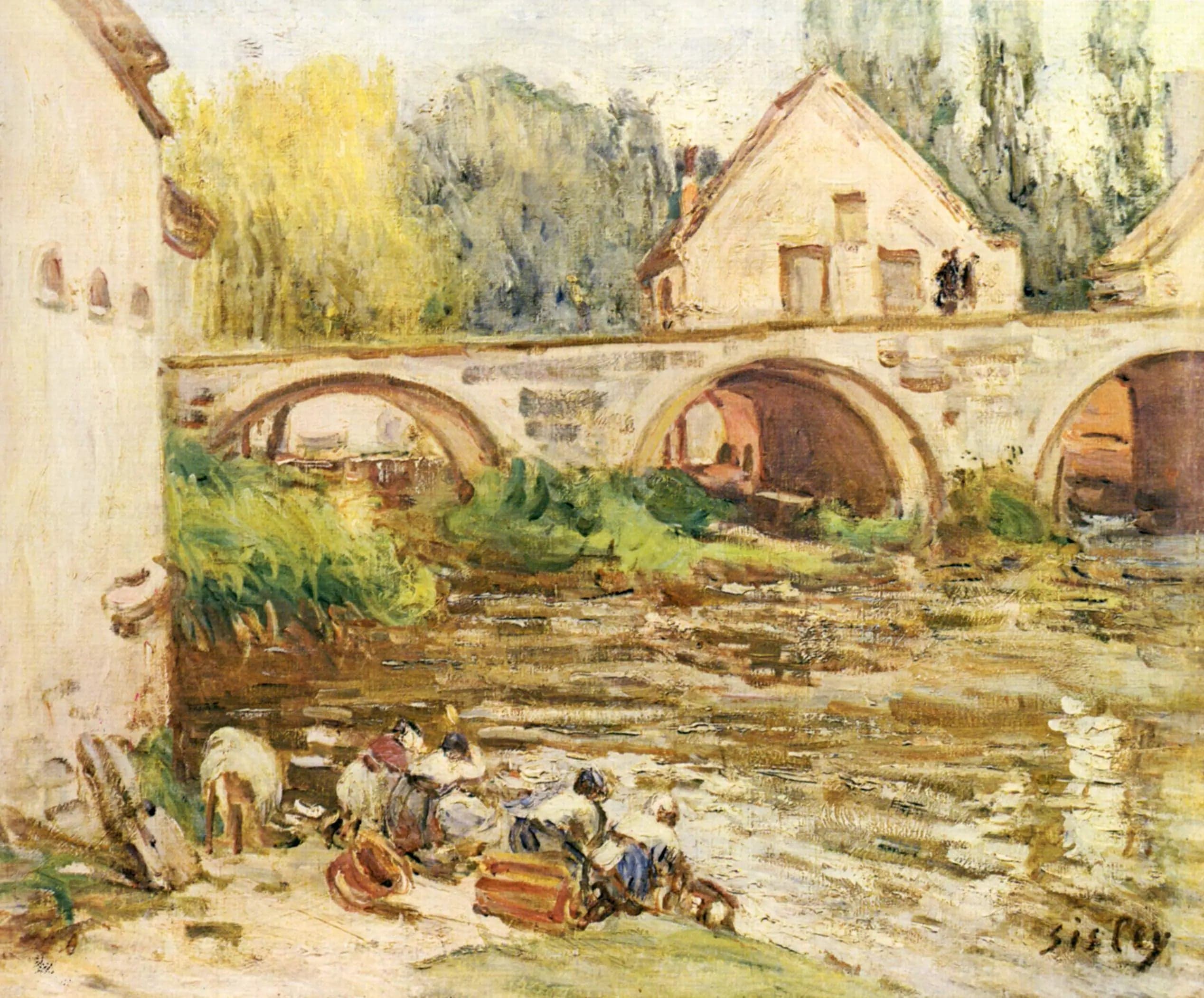
Washerwomen at Moret
- Original dimensions
- 43 x 36 cm
- Museum
- Not specified
- Year
- 1888
Scene depicted
In this painting , Sisley immerses us in the heart of a common activity: hand-washed laundry. The washerwomen, figures of daily labor, are rendered with precision, their silhouettes outlined in delicate arabesques. The reflection of the blue sky on the calm waters enhances the joy of living, while the softness of the colors softens the message. This mastery allows the work to rise above the simple motif, evoking the beauty of a bygone era.
Historical context
Created in 1888, this iconic painting is set in the picturesque backdrop of Moret-sur-Loing, a small French town in the Île-de-France region. Sisley, a major figure of Impressionism , delivers here a composition that reflects the very essence of this artistic movement. This work, immersed in soft light and bucolic landscapes, wonderfully captures the peaceful atmosphere of its time. Although the current location of the painting is not specified, its dimensions of 43 x 36 cm make it both an intimate and evocative piece.
Place in the artist's career
Washerwomen in Moret is part of a period of maturity for Sisley, where his technique reaches impressive mastery. Alongside it, works such as The Bridge at Pontoise and The Road to the Machine for Lightening also illustrate his evolution, from the desire to capture the fleeting moment of nature to a more felt and colorful approach to light. Each painting complements the others, testifying to a rich artistic journey.
Anecdote
Alfred Sisley once stated: “Beauty lies in what is not seen.” This thought seems to have guided his hand as he stood on the banks of the Loing, one spring morning, observing the washerwomen busy at the water's edge. It is in this moment of simplicity, surrounded by the sounds of the water lapping and a scent of wildflowers, that the inspiration for Washerwomen in Moret took shape, transforming an ordinary scene into a true masterpiece.