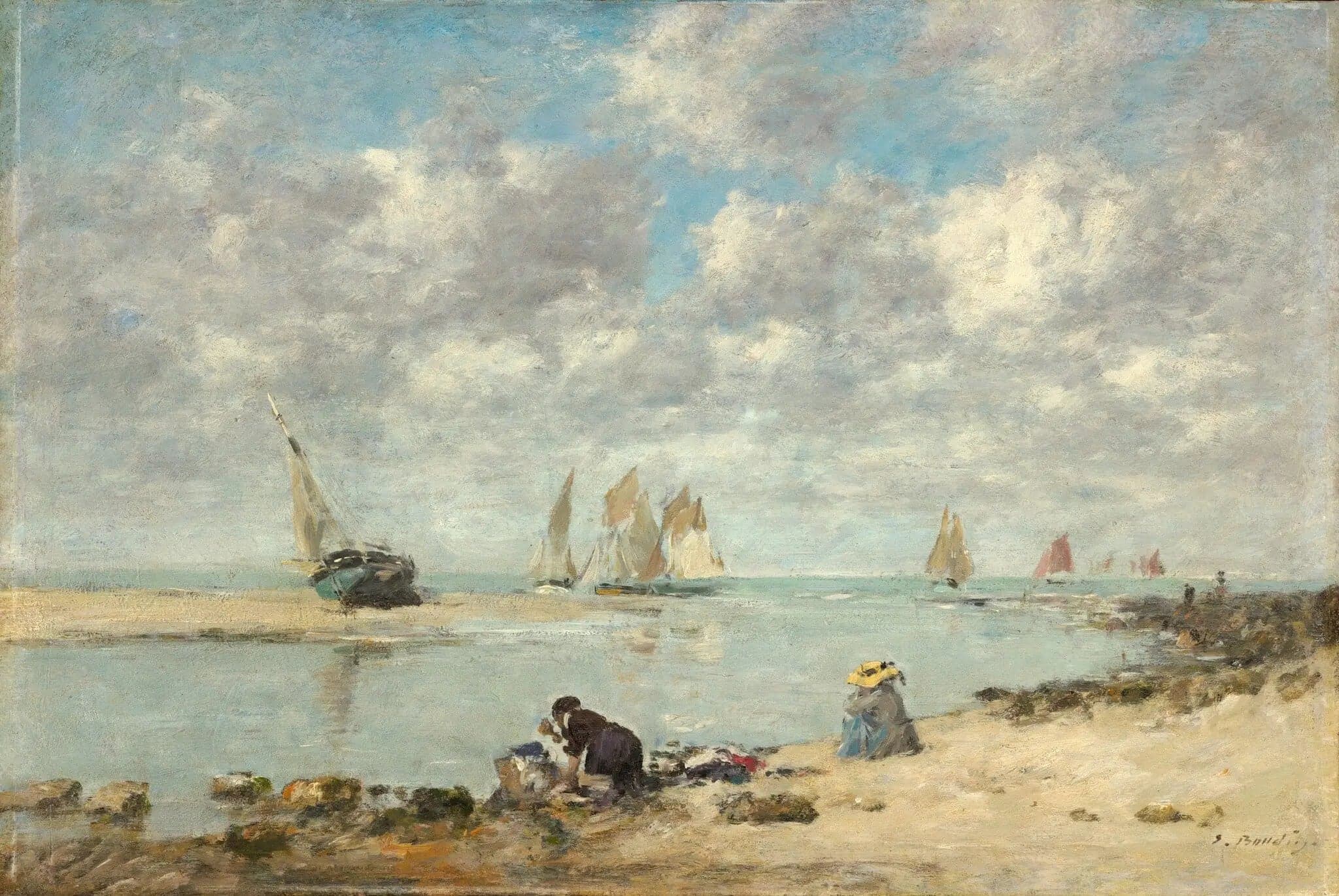
Washerwoman near Trouville
- Original dimensions
- 41.3 x 27.6 cm
- Museum
- National Gallery of Art
- Year
- 1874
Scene depicted
This painting depicts a washerwoman attending to her daily chores on the beach of Trouville, where the reflections of the sea dance with the wind. The vibrant colors of the painting , sometimes soft, sometimes bright, transport us to the heart of an almost living scene, where the viewer can hear the lapping of the water and smell the salty scent of the ocean.
Historical context
Created in 1874, this masterful work unfolds on the sunny shores of Normandy, a time marked by the emergence of the Impressionist movement. In Trouville, a small fishing port, the painting pays tribute to the vitality of maritime life and the wild beauty of nature. Today, this sublime painting is preserved within the National Gallery of Art .
Place in the artist's career
Set in a pivotal period for the artist, “Washerwoman near Trouville” symbolizes a stage of maturity in Eugène Boudin 's journey. Compared to “The Beach of Trouville” and “The Port of Honfleur,” this work illustrates the evolution of his technique, from naturalism to more vibrant and Impressionist compositions.
Anecdote
“I have always sought to capture light, to make it tangible,” Boudin might have stated in the face of the sparkling beauty of a Norman morning. Perhaps he immortalized here a washerwoman, absorbed in her work, the light breeze and the gentle sound of the waves echoing her delicate gesture, thus anchoring his masterpiece in the vibrant soul of the scene.