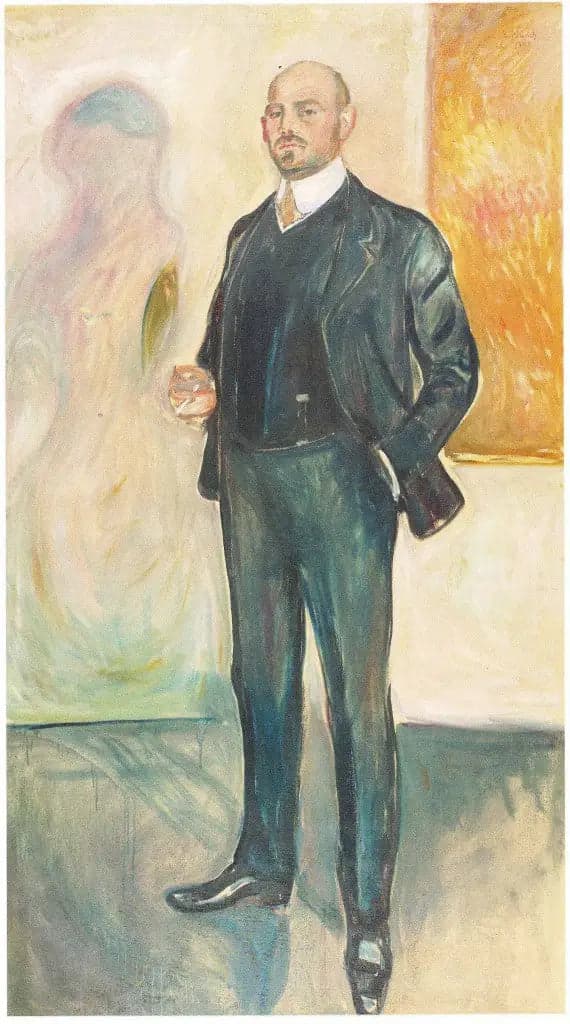
Walter Rathenau
- Original dimensions
- 110 x 220 cm
- Museum
- Bergen Art Museum
- Year
- 1907
Scene depicted
The painting "Walter Rathenau" depicts a striking portrait of the politician and industrialist, emblematic of his time. The intense gaze of the subject, captured by the virtuosity of Edvard Munch , exudes an atmosphere that is both introspective and powerful. This canvas serves as a tribute to Rathenau, associated with themes of modernity and transition. Each stroke resonates as an ode to the struggles and inspirations of a time in full transformation.
Historical context
Created in Bergen, this painting embodies the power of the expressionist movement of which Edvard Munch is an essential pillar. The work, completed in 1907, reveals a period when visual art begins to explore the depths of the human soul. Currently exhibited at the Bergen Art Museum, the canvas holds a prominent place, receiving careful study from art enthusiasts.
Place in the artist's career
This painting is situated at the heart of a crucial phase in Munch's career. Between significant works such as "The Scream" and "The Madonna," the painting "Walter Rathenau" reflects a maturation of his personal style. The complexity of the emotions expressed here marks a technical evolution, where the rigor of portraiture meets the lyrical freedom of expressionism.
Anecdote
Edvard Munch once stated: "Art must be a reflection of human suffering, but also of its radiant beauty." This sentiment inspired him while composing this pictorial work . Imagine him wandering through the winding alleys of Bergen on a cool morning, where the light pierces the veil of shadows, awakening a feverish inspiration for this masterpiece.
Major exhibitions
Edvard Munch : portretter