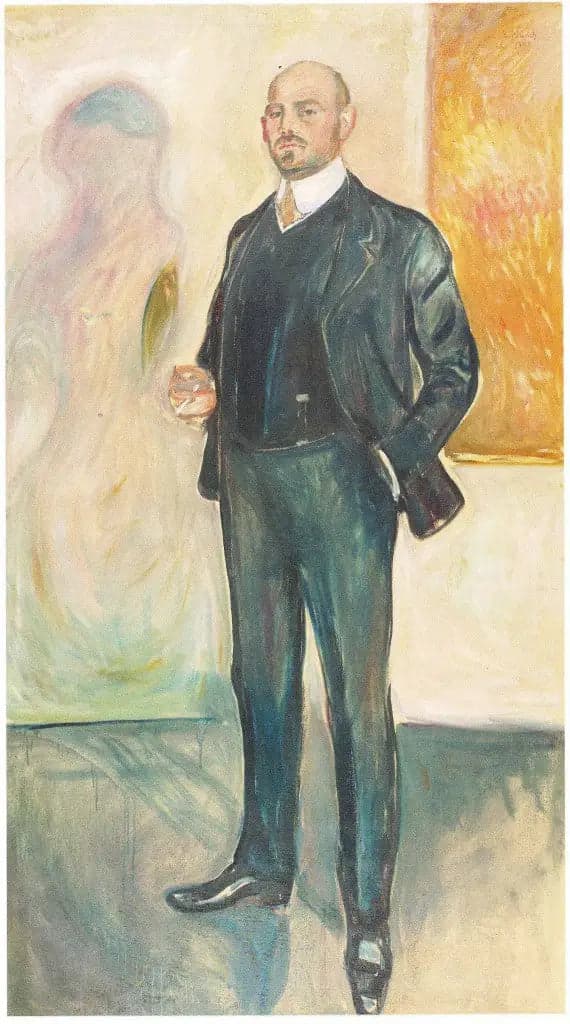
Walter Rathenau
- Original dimensions
- 110 x 200 cm
- Museum
- foundation of the museum of the city of Berlin
- Year
- 1907
Scene depicted
The painting "Walter Rathenau" has a powerful biographical and symbolic character. In the midst of artistic effervescence, Munch seeks to transcend simple portraiture to capture the spiritual essence of his subject. This gathering of colors and forms immerses us in Rathenau's inner universe, revealing a character where thought and emotion intertwine.
Historical context
Created in 1907, in Berlin, this painting belongs to the expressionist movement, an artistic current that disrupted the aesthetic conventions of the time. In a culturally rich context of upheaval, this canvas is deeply rooted in a historical period marked by major social and intellectual advancements. The painting is now located at the foundation of the museum of the city of Berlin, where it continues to fascinate generations of visitors.
Place in the artist's career
This painting is part of a period of maturity for Munch, alongside his major works such as "The Scream" and "The Madonna." These three paintings , although distinct, share a common quest for the expression of suffering and human passion, testifying to a unique stylistic evolution that elevates the artist to the rank of the essential masters of the 20th century.
Anecdote
“Art must be a free expression of man,” said Edvard Munch . Inspired by an unexpected encounter with a man whose face was carved by time, each brushstroke on this canvas evokes the weight of memories and inner struggles. A vibrant emotion rises from this painting , capturing the fragility of the human condition on the threshold of the 20th century.
Major exhibitions
Edvard Munch : portretter