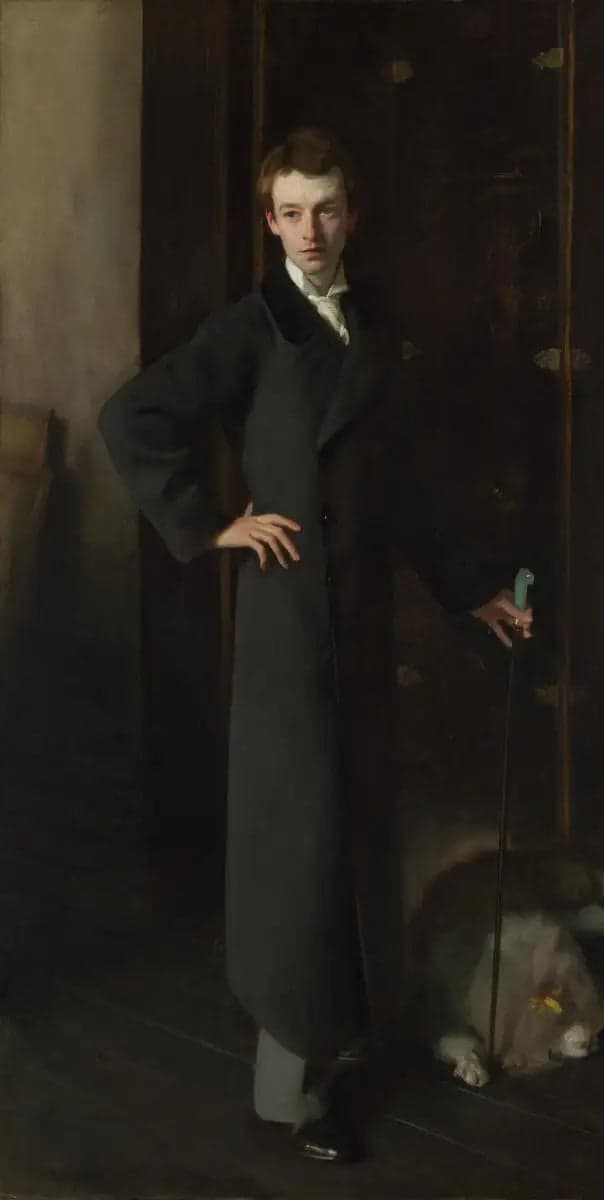
W. Graham Robertson
- Original dimensions
- 230.5 x 118.7 cm
- Museum
- Tate
- Year
- 1894
Scene depicted
In this canvas , Sargent reveals the depth of the soul of W. Graham Robertson, an influential writer of his time. Each brushstroke becomes an emotional surge, translating the intensity of the model's personality. The light-drenched background highlights not only the individual but also the beauty of textures and reflections, transforming this canvas into a rich and immersive visual narrative.
Historical context
Created in 1894, in London, this painting is part of the Impressionist movement sweeping across Europe. In a time when artists seek to capture the slightest nuances of light and human emotion, Sargent's canvas finds its place among the most prized and admired works in the Tate museum, a repository of invaluable wealth.
Place in the artist's career
This painting capitalizes on Sargent's talent, marking a pivotal moment in his career as a portrait artist. In parallel with works such as “Madame X” and “Carnation, Lily, Lily, Rose,” we see an evolution in his approach to human emotion and light, marking here an unparalleled maturity.
Anecdote
One spring morning, John Singer Sargent reportedly said: “Art is a light, a consciousness,” thus expressing his desire to transcend the everyday through his painting . The genesis of the masterpiece “W. Graham Robertson” was marked by a fleeting encounter, a glance exchanged with the model in a quiet alley in London where colors vibrate to the rhythm of the seasons.