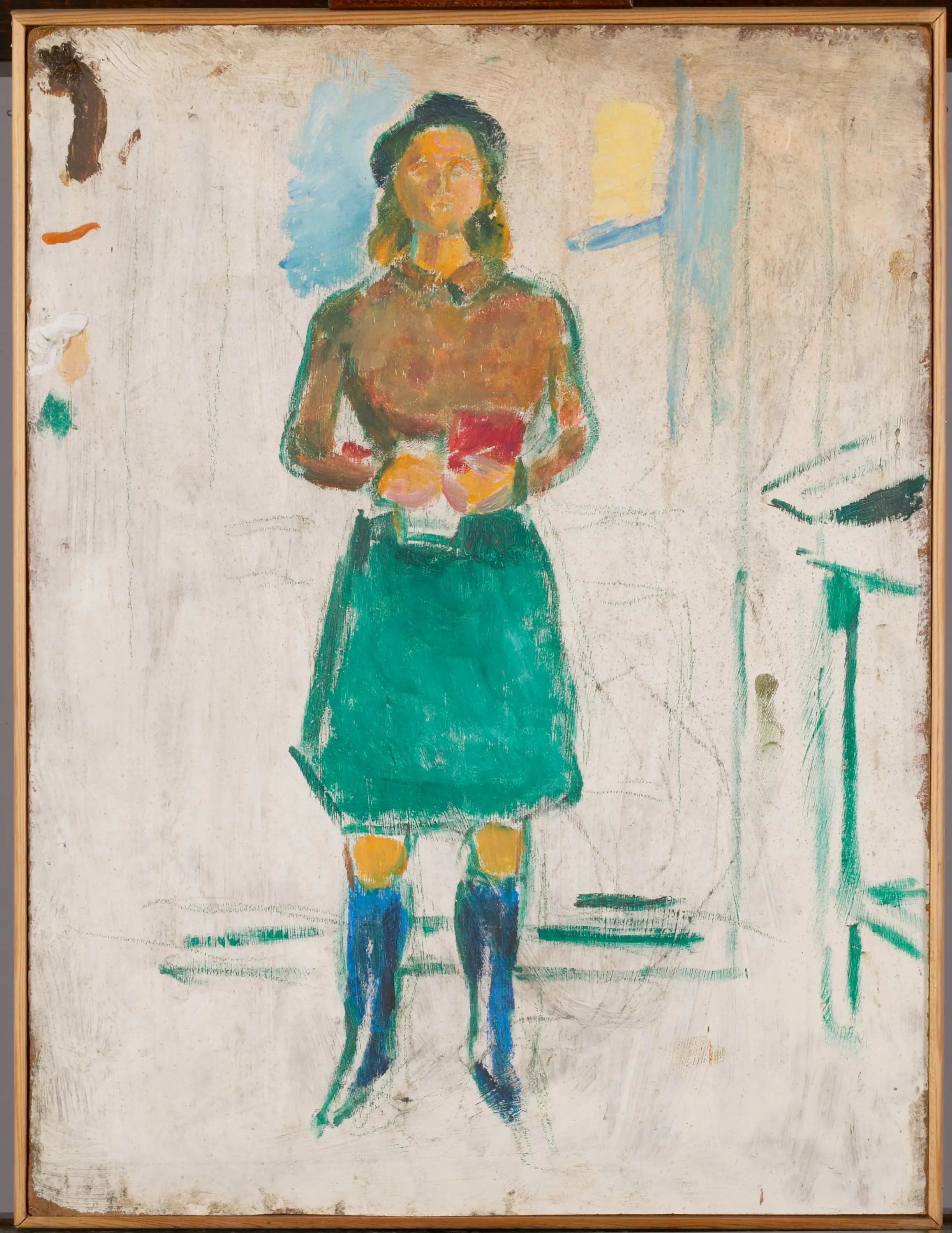
Visit to Ekely
- Original dimensions
- 73.5 x 92 cm
- Museum
- Munch Museum
- Year
- 1942
Scene depicted
In "Visite à Ekely," Munch offers us an intimate scene where life seems suspended. The painting depicts a moment of communion with nature, where the characters capture the echo of the whispers of the wind and the bursts of light. This pictorial work thus becomes a visual refuge, an invitation to contemplation and introspection, revealing the very essence of the human experience.
Historical context
Created in 1942 at the University of Oslo, the painting "Visite à Ekely" is rooted in the context of the expressionist movement, signed by its master Edvard Munch . This iconic painting reflects not only the intensity of human emotions but also the torments of a period oscillating between peace and suffering. Currently exhibited at the Munch Museum in Oslo, this masterpiece transports you to an era where art becomes a profound reflection on the human soul.
Place in the artist's career
This painting is part of a phase of maturity for Edvard Munch , where his style merges elements of emotion with more contemporary influences. Alongside "The Scream" and "The Madonna," "Visite à Ekely" reveals a technical evolution, each painting testifying to his exploration of emotional storms while celebrating ephemeral beauty.
Anecdote
Edvard Munch once confided: "I wanted to capture the fleeting moment when light dances on the canvas of everyday life, a moment of silence filled with life." This reflection was the spark that ignited his creativity during the creation of the canvas . Imagine a spring morning in Ekely, where the gentle breeze makes the leaves dance, and where every color seems to vibrate under the sun, inspiring this vibrant and evocative pictorial work.
Major exhibitions
Edvard Munch and his models: 1912-1943