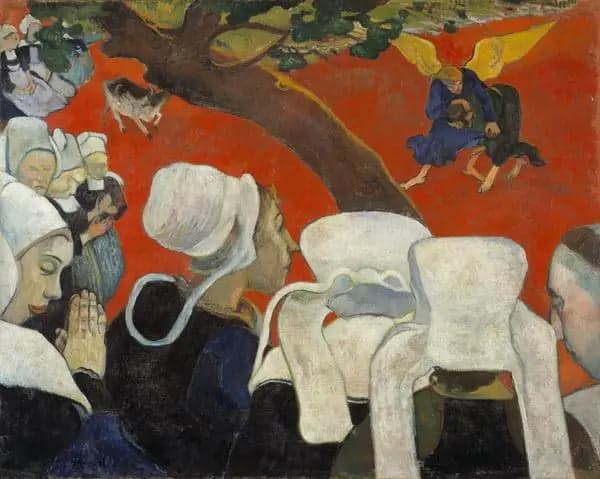
Vision After the Sermon
- Original dimensions
- 91 x 72.2 cm
- Movement
- post impressionism
- Museum
- National Gallery of Scotland
- Year
- 1888
Scene depicted
“Vision after the sermon” represents a sacred, sublime moment, where women in prayer witness the vision of a spiritual battle between Jacob and the angel. The scene is set against an intense red background, symbolizing the spiritual struggle while the vivid figures, as if drawn from a dream, dominate the scene. Boldly, Gauguin juxtaposes religious reality with the spiritual world, thus offering an innovative perspective on sacred painting .
Historical context
In 1888, the artist Paul Gauguin , then immersed in the invigorating setting of Pont-Aven, created the iconic painting "Vision after the sermon". This canvas is part of the post impressionist movement, which seeks to transcend reality to infuse it with a new emotional dimension. Exhibited at the National Gallery of Scotland, this painting measuring 91 x 72.2 cm is a true witness to the artistic fervor of an era at a crossroads.
Place in the artist's career
“Vision after the sermon” is a pivotal work in Gauguin's career, marking his transition from an impressionist style to a more symbolic and personal approach. In parallel, his paintings “The Night” and “The Alyscamps” illustrate a technical evolution towards a simplification of forms and a deep exploration of colors. Here, the pictorial technique marries an inner vision, testifying to a phase of artistic maturity.
Anecdote
“True painting is not what one sees, but what one feels.” These words of Paul Gauguin resonate throughout his canvas . On the morning of its creation, while strolling through the quiet streets of Pont-Aven, a sparkling vision of divine energy imposes itself upon him. This revelation – the struggle between Jacob and the angel – transforms into a textured jewel at the heart of his painting , evoking emotion and mystery.