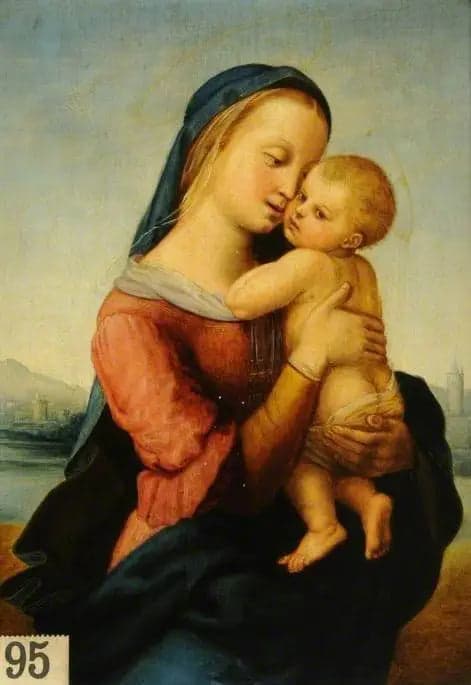
Virgin and Child
- Original dimensions
- 29.5 x 38.5 cm
- Museum
- William Morris Gallery
Scene depicted
The canvas "Vierge à l'Enfant" depicts a moment of tenderness between Mary and her child Jesus, in a serene setting where every detail matters. The pictorial work evokes both maternal sweetness and sacred dignity, a luminous composition that transports the viewer into a universe of religious intimacy and beauty. The gaze of the Child, full of wonder, invites deep reflection on the nature of the bond between mother and son.
Historical context
Created in the early 16th century in Rome, the painting "Vierge à l'Enfant" is part of the lineage of the Italian Renaissance , an artistic movement that celebrates the return to classical antiquity as well as a humanistic approach to the divine. Today, this canvas majestically resides at the William Morris Gallery, where it continues to evoke the splendor of a bygone era, fascinating visitors with its delicate dimensions and artistic intelligence.
Place in the artist's career
This painting marks a turning point in the career of Raphael , illustrating his ability to blend emotion and technique. It stands alongside other iconic works like "The Sistine Madonna" and "The Transfiguration," showing an evolution in his exploration of light and color, while testifying to his mature style characterized by a balance between the sacred and the everyday.
Anecdote
“Art is an expression of timeless beauty,” could have whispered Raphael while painting this masterpiece. Imagine him, one spring morning in Rome, inspired by the soft light filtering through the stained glass of a church, capturing the innocence of a child and the grace of a mother. This painting then becomes a reflection of the divine, a palpable emotional surge with every brushstroke.