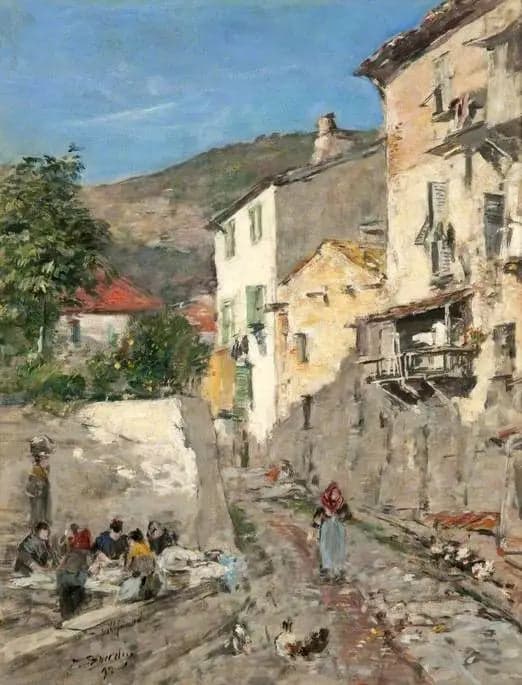
Villefranche
- Original dimensions
- 32.8 x 39.1 cm
- Museum
- Glasgow Museums Resource Centre
- Year
- 1892
Scene depicted
In this painting, Boudin transports us directly to the bustling port of Villefranche-sur-Mer, where the horizon mingles with the dance of white sails. The play of light on the water, the shimmering reflections, the dome of the mountains enveloping the bay, all immerse us in a vibrant atmosphere, full of life. This pictorial work becomes a poignant testimony of the daily life of the inhabitants inspired by the sea.
Historical context
Created in 1892 in Villefranche, this work is emblematic of the Impressionist movement of which Eugène Boudin is one of the pioneers. His painting, currently exhibited at the Glasgow Museums Resource Centre, captures the essence of a time when light and color were both subjects of study and forms of expression. With dimensions of 32.8 x 39.1 cm, this oil painting is a window into France at the end of the 19th century.
Place in the artist's career
This painting represents one of the stylistic peaks of Boudin, a phase where his technical mastery is highlighted. Compared to other masters such as Monet with his canvas “Impression, Sunrise” and Sisley with his painting “The Seine at Argenteuil,” Villefranche illustrates the evolution of Boudin's gaze on light and sea air. His journey takes on a new dimension, propelling his art beyond the shores of Normandy.
Anecdote
“The sea has never ceased to inspire my soul,” Boudin might have said while recalling his attachment to the coastal scene of Villefranche. On a sunny morning, a light breeze lifting the fragrances of sea salt, the artist allows himself to be immersed in the beauty of the place, which then becomes the foundation of his masterpiece. The painting narrates this magical moment, immortalizing the emotion of a landscape in perpetual motion.