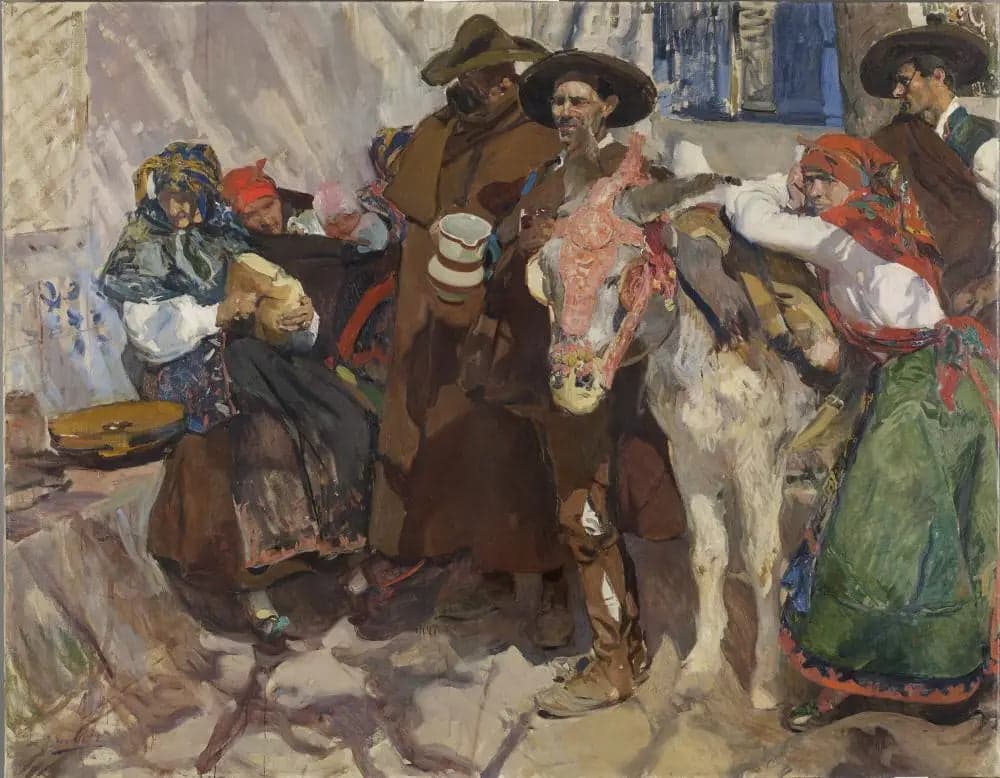
Villagers of Léon
- Original dimensions
- 253.6 x 198.6 cm
- Museum
- The Hispanic Society of America
- Year
- 1907
Scene depicted
In this painting , Sorolla immerses us in the heart of a village life scene, where the daily life of the inhabitants of Léon is illuminated by the play of shadows and light. The figures, authentic and natural, seem to dance under the sun, creating an atmosphere of harmony and human warmth. Sorolla immortalizes a fleeting moment, an interconnection between man and nature, making every detail alive and endearing.
Historical context
Created in 1907, this painting is at the heart of the artistic dynamic of Spain at the dawn of the 20th century. Joaquín Sorolla , a master of light and color, anchors his work in the Impressionist movement, while integrating influences from Spanish luminism. The painting we are interested in is currently at the Hispanic Society of America in New York, where it continues to awaken passions with its impressive dimensions and radiant beauty.
Place in the artist's career
Villageois de Léon is part of a pivotal period in Sorolla's career, as he explores themes of rural life and the intimate relationship with light. Preceding works such as La plage de Valencia and Le retour de la pêche , this painting shows a clear evolution: a mastery of light and an increasingly empathetic gaze towards the world around him.
Anecdote
“Light is my subject, and every painting I create is an ode to its splendor.” These words from Sorolla resonate deeply with his masterpiece , Villageois de Léon . Imagine him, one spring morning, wandering through the streets of Léon, capturing the simplicity and beauty of the villagers' faces as the light reflects off their tanned skin. This precious inspiration finds an intimate and vibrant place on the canvas.