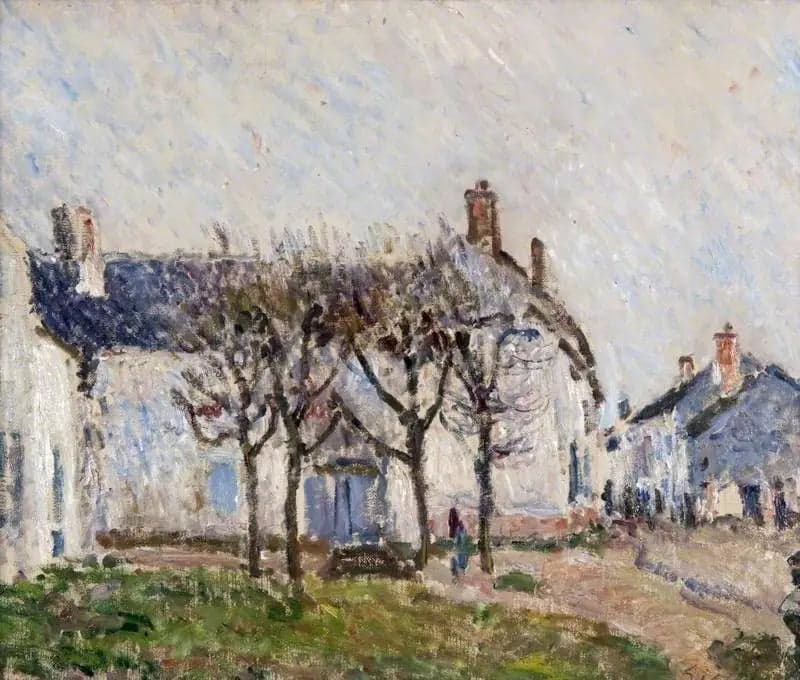
Village Street, Moret-sur-Loing
- Original dimensions
- 46 x 35.1 cm
- Museum
- Kelvingrove Art Gallery and Museum
- Year
- 1894
Scene depicted
In this pictorial work, Sisley succeeds in immortalizing a duality between the tranquility of village life and the power of the surrounding light, creating a serene atmosphere. The small houses lined along the street seem to bloom under the sun's rays, while the nearby river adds a dimension of elegance and softness. Sisley's art transcends the simple visual; it invites one to feel every moment captured.
Historical context
Created in 1894, this painting embodies the charm of Moret-sur-Loing, a picturesque commune in the heart of the Île-de-France region. Alfred Sisley , a major figure of the Impressionist movement, captures the essence of a time when light plays a crucial role, oscillating between tangible reality and colorful dreams. Currently housed at the Kelvingrove Art Gallery and Museum , this canvas measuring 46 x 35.1 cm is a perfect example of the harmony between art and nature, reflecting an era where every street corner told a story.
Place in the artist's career
The painting Rue du Village, Moret-sur-Loing stands as one of the key works in Alfred Sisley's career. At this time, he is at a crossroads in his Impressionist style, where mastery of light and color reaches new heights. In comparison, earlier works like Le Pont d’Argenteuil and later creations, such as La Seine à Port-Marly, demonstrate an exciting evolution from an Impressionist to a more avant-garde artist while maintaining his luminous signature.
Anecdote
“Every masterpiece is born from a breath, from a moment,” said Sisley. He found his inspiration on a peaceful morning when the dawn light caressed the cobblestones. On this quiet road, cradled by the gentle murmur of nature, he felt the urgent need to show the world the fleeting beauty of this scene. This painting thus becomes not only a representation but a true visual poem.