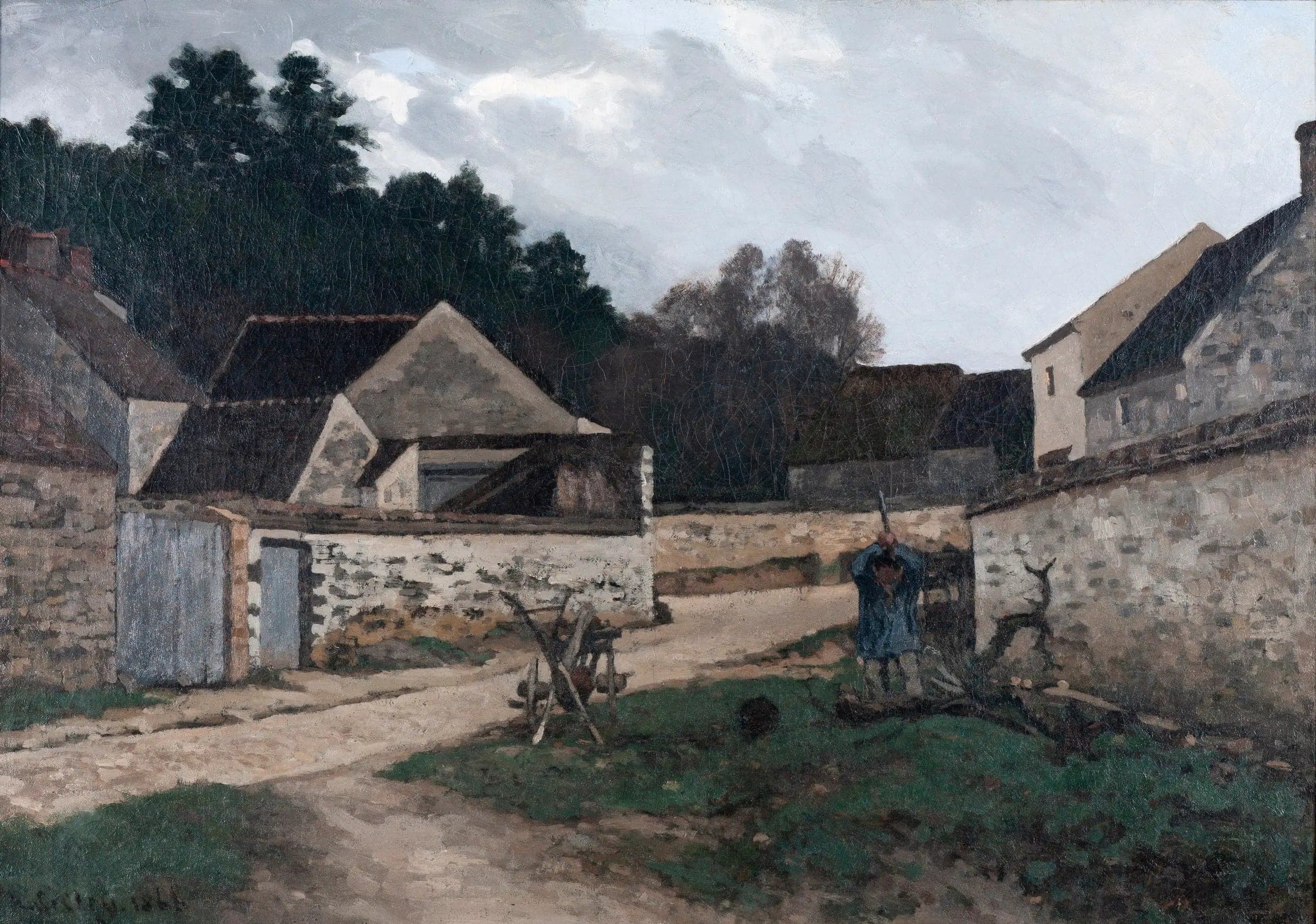
Village Street in Marlotte, near Fontainebleau
- Original dimensions
- 111.1 x 84.7 cm
- Museum
- Albright-Knox Art Gallery
- Year
- 1866
Scene depicted
In this work, Sisley depicts a peaceful street of a village, brushed by soft and bright light. The stone houses line up discreetly, integrated into a lush landscape that stretches as far as the eye can see. The canvas reveals a tranquil atmosphere, where time seems suspended, a frozen moment that calls for contemplation. Shadows and lights intertwine, inviting a dialogue between the observer and the delicate scene offered by this painting .
Historical context
Created in 1866, this painting by Alfred Sisley evokes a charming village near Fontainebleau, France. Inscribed in the Impressionist movement, this canvas testifies to a time when light and nature became the true subjects of our painting . Currently exhibited at the Albright-Knox Art Gallery , it measures 111.1 x 84.7 cm, a size that allows the viewer to immerse themselves in the serenity of the rural scene.
Place in the artist's career
Village Street in Marlotte, near Fontainebleau is part of a crucial stage in Alfred Sisley's career, where he refines his Impressionist style. In parallel, works such as Boulevards of Paris and The Seine at Argenteuil illustrate his ability to immortalize light and color, demonstrating his technical and emotional evolution over the years.
Anecdote
“Nature is my muse.” This quote summarizes the deep connection that Alfred Sisley had with his environment. The inspiration for his masterpiece sprang forth on a spring morning, as the sun's rays danced on the quiet streets, bringing an ambiance of peace. Each brushstroke in the painting invites the viewer to feel the awakening of nature, capturing a precious fleeting essence.