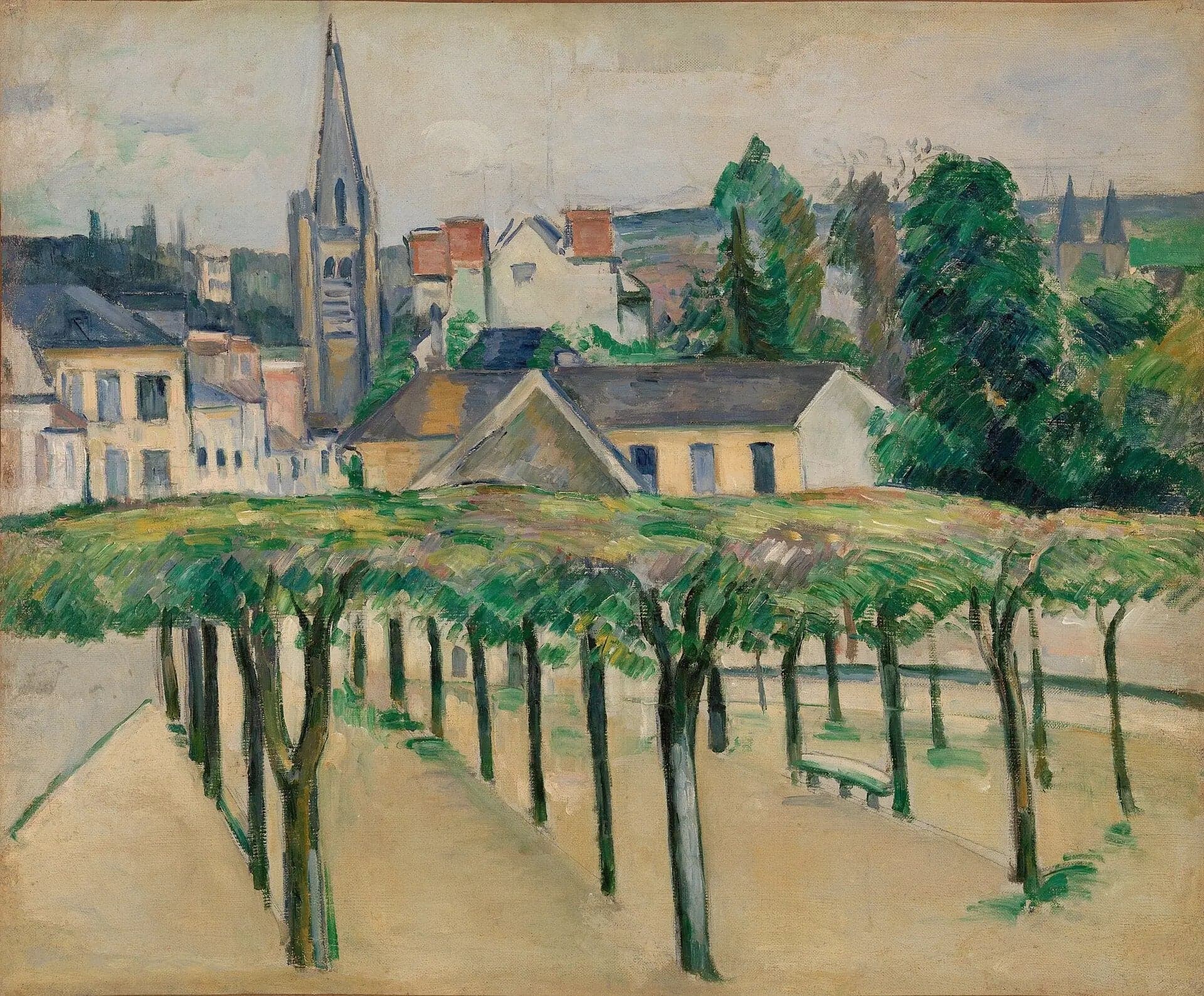
Village Square
- Original dimensions
- 64.4 x 53 cm
- Museum
- Barnes Foundation
- Year
- 1879
Scene depicted
This painting, titled “Village Square,” presents a peaceful scene where the inhabitants cross paths, illustrating the harmony between man and his environment. The buildings, with their tiled roofs and soft-colored facades, seem to live in rhythm with the surrounding nature. With an open composition, Cézanne invites us to share this reality, to feel the fresh air and the distant sounds of a quiet town, like a sweet memory that awakens nostalgia.
Historical context
Created in 1879, this painting emanates from the vibrant studio of Paul Cézanne , located in Aix-en-Provence, an iconic city in the south of France. Through his work, the artist is part of the Impressionist movement, before turning to a more personal style, foreshadowing Cubism and an innovative approach to composition. Today, this exceptional canvas is preserved at the Barnes Foundation , a museum renowned for its collection of Impressionist and Post-Impressionist works. With dimensions of 64.4 x 53 cm, this canvas is a true reflection of the artistic excellence of its time.
Place in the artist's career
“Village Square” is part of a major period in Cézanne's career, marking his transition to a more liberated expression of form. Alongside other works such as “The Card Players” and “Still Life with Apples and Biscuits,” an impressive evolution of his technique can be observed. This painting represents a transition to artistic maturity, where he masterfully merges color, light, and form, thus creating a timeless masterpiece .
Anecdote
“Nature is the greatest of masters, it speaks to the soul, and I seek to listen to it.” By capturing family scenes outdoors, Cézanne draws his inspiration during a sweet and sunny afternoon in his hometown. These moments of calm and beauty are found in every brushstroke of the painting , where light and shadows dance on the canvas , creating a striking atmosphere.