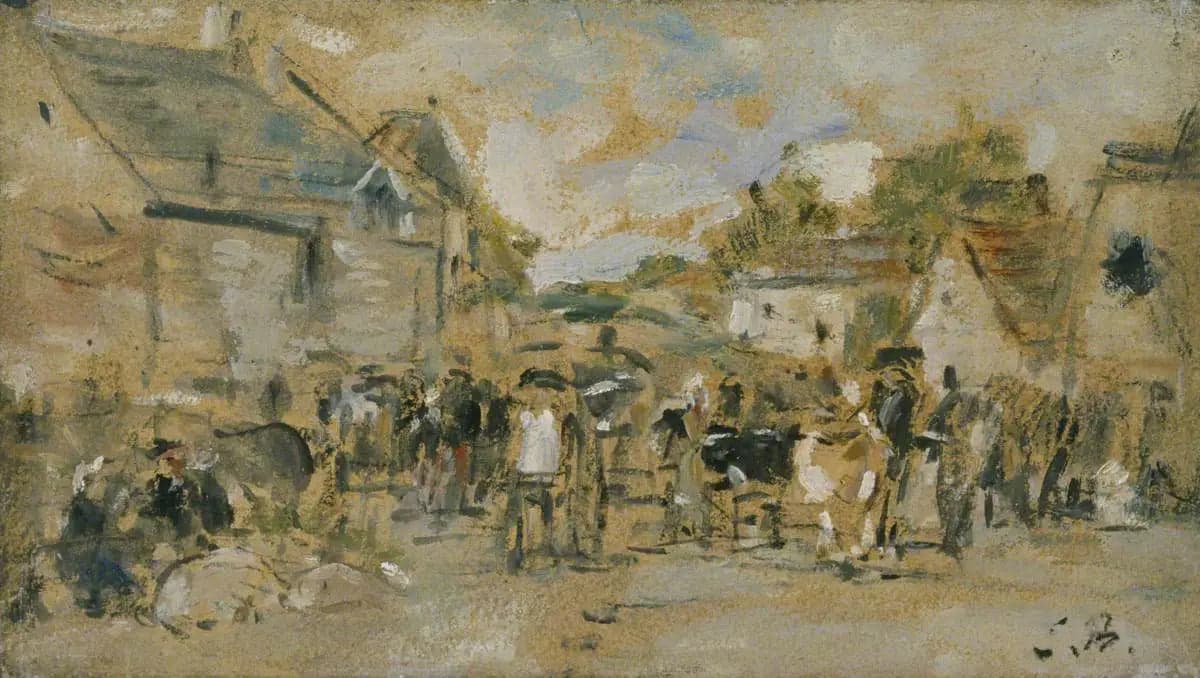
Village Market
- Original dimensions
- 26 x 11.2 cm
- Museum
- National Museum of Cardiff
- Year
- 1890
Scene depicted
The painting "Marché du village" illustrates a vibrant folkloric scene, where peasants and villagers exchange fresh goods. The shimmering color palettes bring this community, united by trade and friendship, to life. The figures, although stylized, seem to come alive before our eyes, creating an atmosphere that is both familiar and nostalgic.
Historical context
Created in 1890 through the passionate gaze of Eugène Boudin , this iconic painting captures the essence of the French village market, a pictorial genre characteristic of the Impressionist movement. At that time, France was in the midst of artistic effervescence, particularly in Honfleur, a maritime town that provides an idyllic setting for this composition. The painting is currently housed in the National Museum of Cardiff , where it continues to enchant visitors.
Place in the artist's career
This painting is very representative and is situated at a key stage in Eugène Boudin's career, as he seeks to perfect his Impressionist style while retaining classical touches. Compared to other paintings like "La Plage à Trouville" and "Les Bateaux de Honfleur," "Marché du village" illustrates the evolution of his technique, moving from static scenes to a dynamic fluidity full of life.
Anecdote
Boudin used to say: "One must paint life as it comes, with all its beauty and triviality." This thought led him to immortalize a market morning, the laughter of children, the scent of warm bread, that moment suspended between excitement and serenity. This pictorial work , like an open window to the past, reminds us of the simplicity and joy of human encounters.