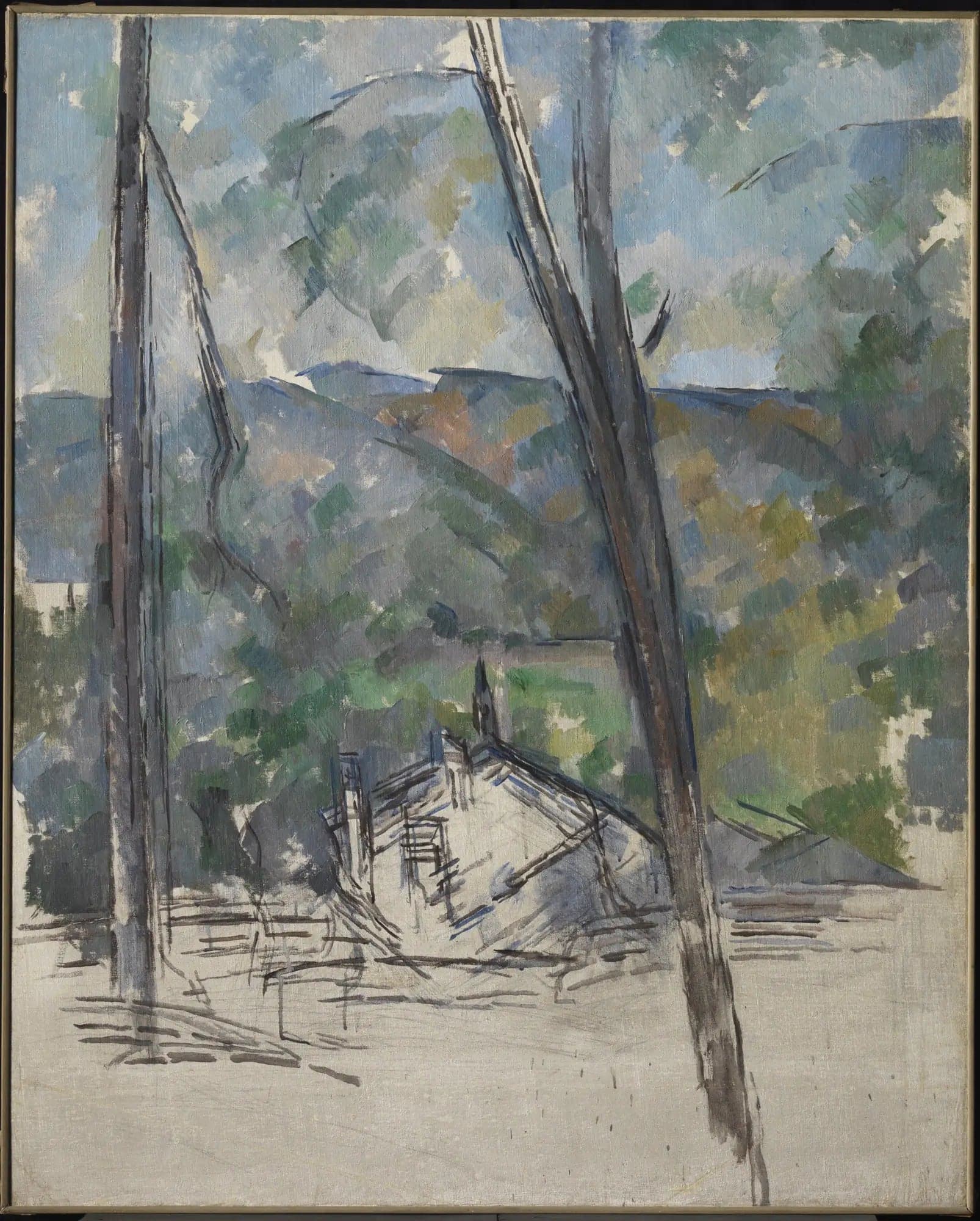
View towards the Tholonet road near the Château Noir
- Original dimensions
- 81.3 x 101.1 cm
- Museum
- Princeton University Art Museum
- Year
- 1900
Scene depicted
This painting intersects valleys and skies, offering a serene view where the beauty of the landscape reveals itself in every brushstroke. The road winds, tracing the path of the soul, while the tranquility of the Château Noir asserts itself on the horizon, a symbol of a glorious past and an omnipresent nature.
Historical context
Created in 1900, this painting embodies its roots in the Provençal landscape. Paul Cézanne , master of post-impressionism , sketched this canvas near the Château Noir, a place rich in history. Currently, this canvas is housed in the Princeton University Art Museum , a setting that pays tribute to it. The dimensions of the work, 81.3 x 101.1 cm, reflect the artistic ambition of the artist.
Place in the artist's career
This painting marks a turning point in Cézanne's career, illustrating both his mature style and his love for Provence. Like “The Montagne Sainte-Victoire” and “The Large Bathers,” it reveals an evolution towards poetic abstraction while preserving the richness of colors and forms.
Anecdote
“Nature is my palette and I am its servant,” said Cézanne, inspired by the changing lights of a spring morning. It is in this quest for representation of the real that he brought this masterpiece to life. The light in this painting evokes the song of birds and the scent of pines, transporting us to the first light rising over the Tholonet Road.