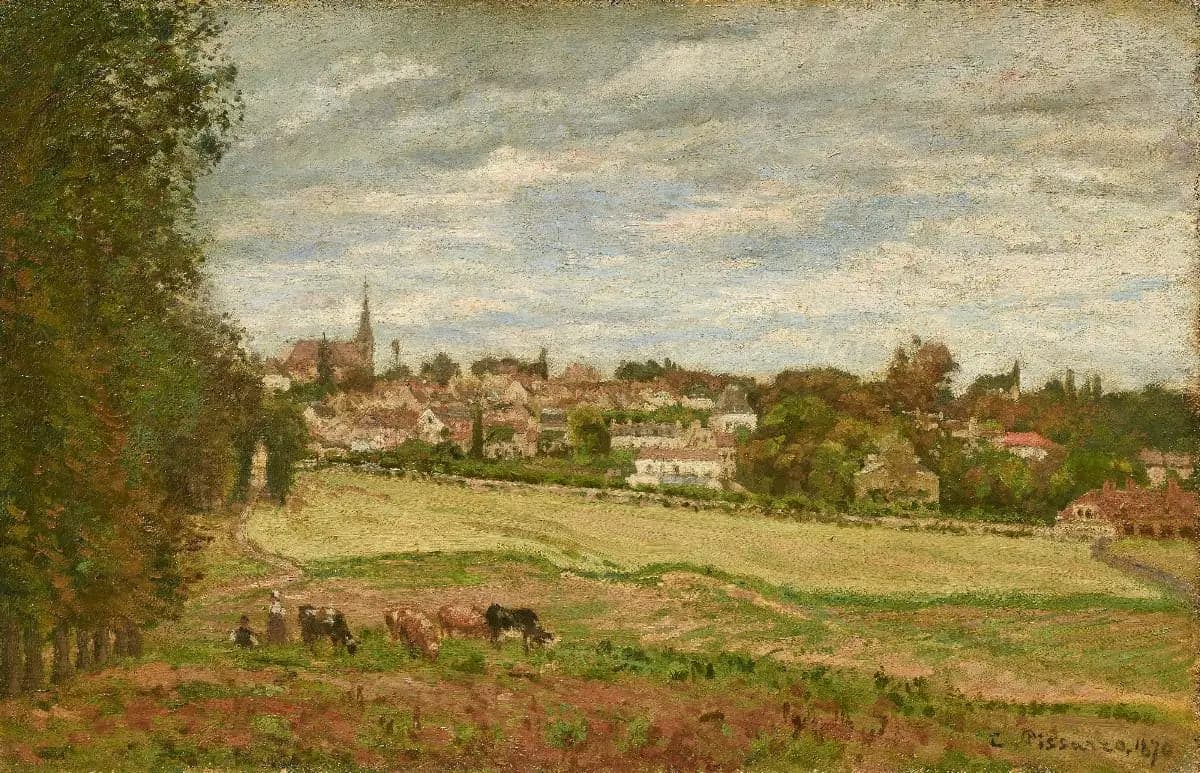
View of the Village of Marly-le-Roi
- Original dimensions
- 71 x 46 cm
- Museum
- Kunsthaus Zurich
- Year
- 1870
Scene depicted
Here is a scene that tells a unique story: a village standing in all its splendor, with its modest buildings embraced by a refreshing green setting. Farmers bustle on the fertile soil, illustrating daily life and the deep bond between man and his environment. The painting , through its delicate brushstrokes and vibrant hues, evokes a tranquility that is both nostalgic and alive.
Historical context
Created in 1870, this painting immerses the viewer in Essonne, a region that still echoes the Impressionist movement. At that time, Camille Pissarro was already influenced by the bucolic architecture of Marly-le-Roi and inspired by the sociocultural context of pre-revolutionary France. The canvas , currently housed at the Kunsthaus Zurich , bears witness to the artist's indelible artistic legacy, as well as its remarkable dimensions that give it an imposing presence.
Place in the artist's career
This canvas fits into a pivotal period of Pissarro's career, symbolizing his transition to a greater mastery of light and color. Alongside his other notable works, such as "The Harvest" and "The Place of the French Theater," this masterpiece reveals an expansion of his pictorial vocabulary, combining academic technique and raw emotion.
Anecdote
“Light is everything,” Pissarro said, reflecting his love for the landscape he painted. Imagine a cool spring morning, the golden rays of the sun making their way through the morning mist, revealing the hidden beauty of the village he immortalized in this masterpiece . Inspiration came to him as he stood on a hill, a breath of air filled with floral and earthy scents penetrating his senses, rekindling his enthusiasm for a canvas that the public would admire more than a century later.