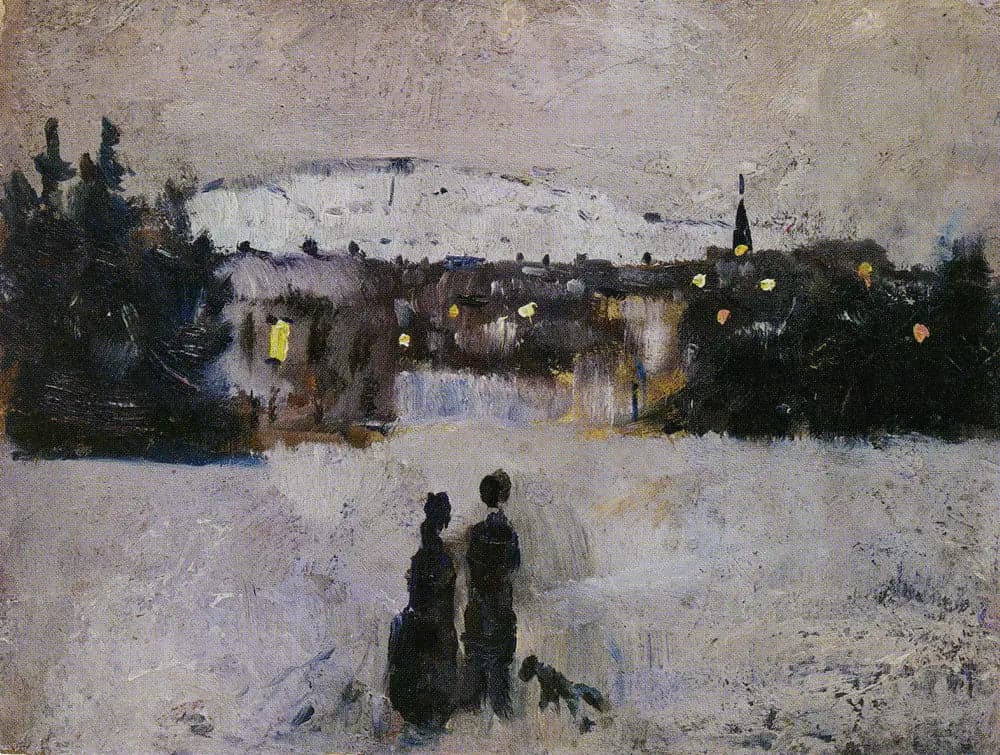
View of the city on a winter day
- Original dimensions
- 23.5 x 18.5 cm
- Museum
- Not specified
- Year
- 1882
Scene depicted
In View of the City on a Winter's Day , Munch depicts a city at the heart of the cold season, enveloped in a mysterious fog. The paths are covered in snow, and the silhouettes of the buildings seem to blend into a winter melody. It is a composition where silence and tranquility intertwine, creating an unreal atmosphere, like a dream frozen in time.
Historical context
Created in the heart of the Norwegian winter, View of the City on a Winter's Day is an iconic painting that captures the very essence of Oslo at the end of the 19th century. Edvard Munch , a leading figure of the expressionist movement, unfolds here an introspective and melancholic atmosphere, characteristic of his work. This painting, currently kept in the archives, reflects a personal perspective on nature and the urban construction of his time.
Place in the artist's career
This painting is situated at the beginning of Munch's career, marking a turning point in his exploration of inner reality. It evokes works such as The Scream , with its strong sensitivity to anxiety, and The Dance of Life , revealing the duality between joy and melancholy. This period reveals his artistic quest towards human sensations, thus foreshadowing his key words: emotion and perception.
Anecdote
“Winter is my mind, my painting my truth.” These words resonate in Munch's mind as he captures a frosty morning through the window of a café. It is in this morning silence that he finds inspiration for his canvas , infusing his masterpiece with a palpable emotion, where the solitude of a winter's day is illustrated with finesse.