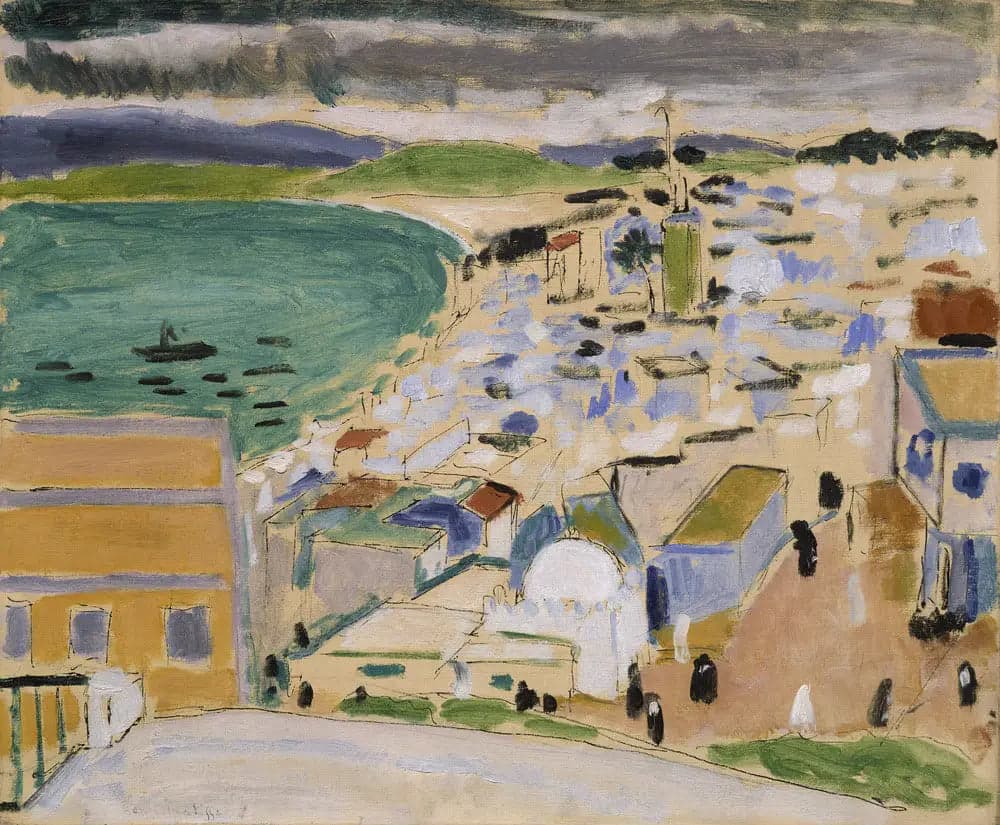
View of the Bay of Tangier
- Original dimensions
- 55 x 46 cm
- Museum
- Grenoble Museum
- Year
- 1912
Scene depicted
This painting tells a stripped-down story, where the turquoise sea, scattered boats, and surrounding hills blend into a harmonious composition. The landscape, bathed in light, evokes the dynamism of a day by the sea. One can almost hear the gentle murmur of the waves and the distant call of the seagulls, so well does Matisse manage to capture the living essence of this bay.
Historical context
Created in 1912, this iconic painting finds its roots in the movement of Fauvism , advocating expressionism through color. Located in Tangier, a captivating city in Morocco, this work immortalizes the vibrant essence of its environment, from the shimmering reflections of the Mediterranean to the tranquility of the landscapes. Currently housed in the Grenoble Museum , View of the Bay of Tangier captures the magic of a moment.
Place in the artist's career
View of the Bay of Tangier fits into a key period of Matisse's career, where his style evolves towards a simplification of forms and an intensification of colors. Compared to other works of his like The Dance (1910) and The Joy of Life (1905-1906), this painting reveals a serene maturity while maintaining its coloristic boldness.
Anecdote
“Color is a means of making the spirit visible,” Matisse might have said when discussing the inspiration behind his masterpiece . Imagine him on a sunny morning aboard a boat, admiring the panorama: where the sky meets the sea, and where the scents of citrus float in the air, nourishing his creativity. This emotion powerfully translates in View of the Bay of Tangier .