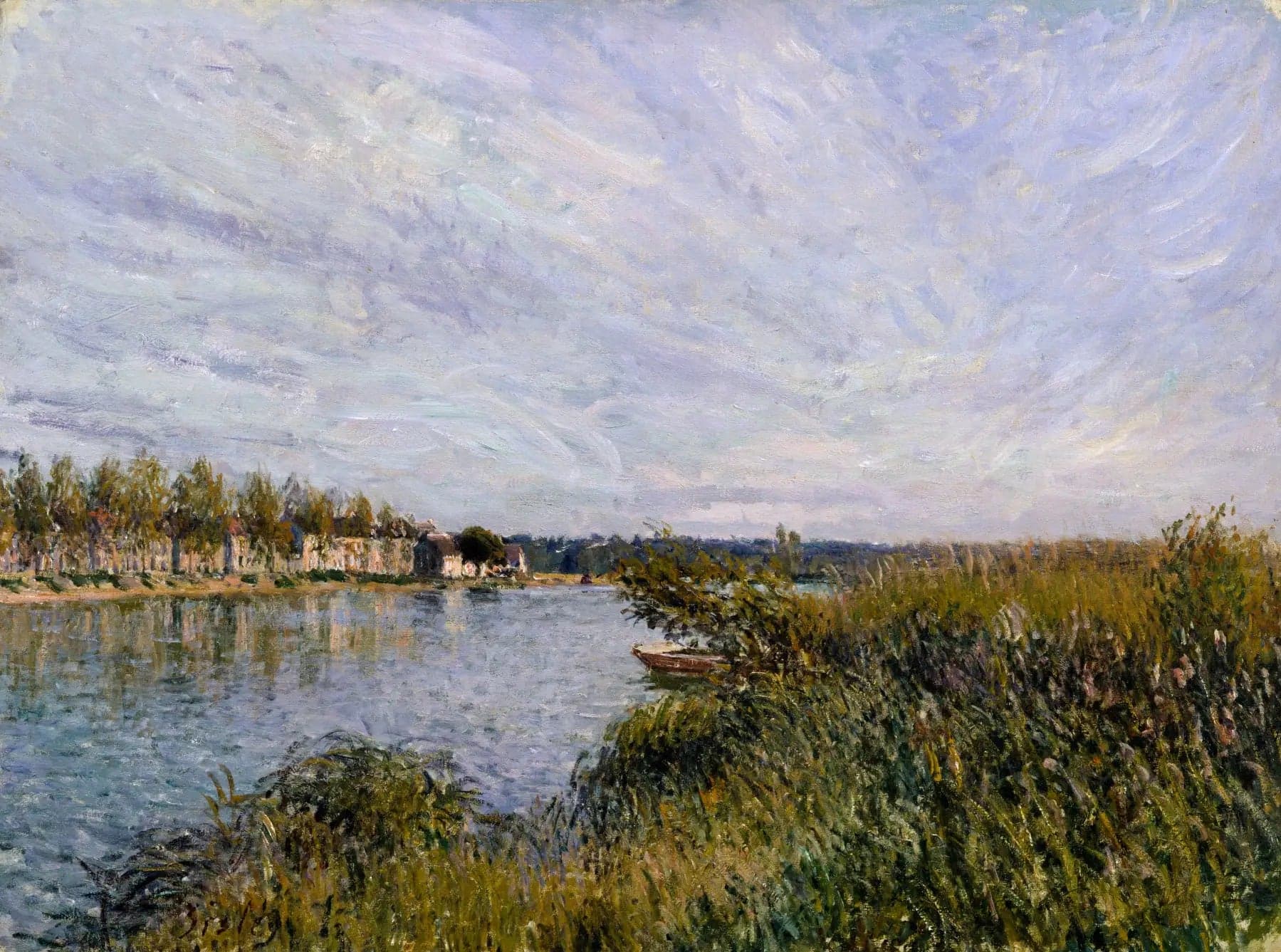
View of Saint-Mammès
- Original dimensions
- 73.7 x 54.61 cm
- Museum
- Carnegie Museum of Art
- Year
- 1881
Scene depicted
In “View of Saint-Mammès,” Sisley transports us to the heart of an idyllic landscape, where the gentle reflections of the water dance under changing light. This scene, both peaceful and vibrant, evokes the serenity of an ordinary day, transcended by the magic of impressionism , which consists of capturing the ephemeral. The sailboats, the lush banks, and the cloudy sky intertwine harmoniously, inviting the viewer to immerse themselves in this fleeting moment.
Historical context
Created in 1881, this iconic painting finds its roots in Saint-Mammès, a small peaceful commune located at the confluence of the Seine and the Marne, in France. This work is a privileged witness of the impressionist movement, which marked the artistic landscape of the late 19th century. Currently preserved at the Carnegie Museum of Art , this masterpiece measures 73.7 x 54.61 cm, a size that allows for the appreciation of every detail of its luminous composition.
Place in the artist's career
“View of Saint-Mammès” stands as a pivotal moment in Alfred Sisley's career. This painting reflects a stylistic maturity, following works like “The Washing” (1862) and “The Banks of the Seine at Argenteuil” (1874) that testify to his technical evolution. Here, Sisley masters the harmony of colors and light, making this canvas a key work in his impressionist repertoire.
Anecdote
“Light is a song that one perceives only with the heart,” could have declared Alfred Sisley when recalling his feelings during the execution of this painting. Inspired by the gentle summer mornings, he captures the moment when the mist rises over the river, a moment suspended in time, like a silent walk by the water, rhythmically accompanied by the whisper of the waves.
Major exhibitions
Paul Durand-Ruel, the bet of impressionism