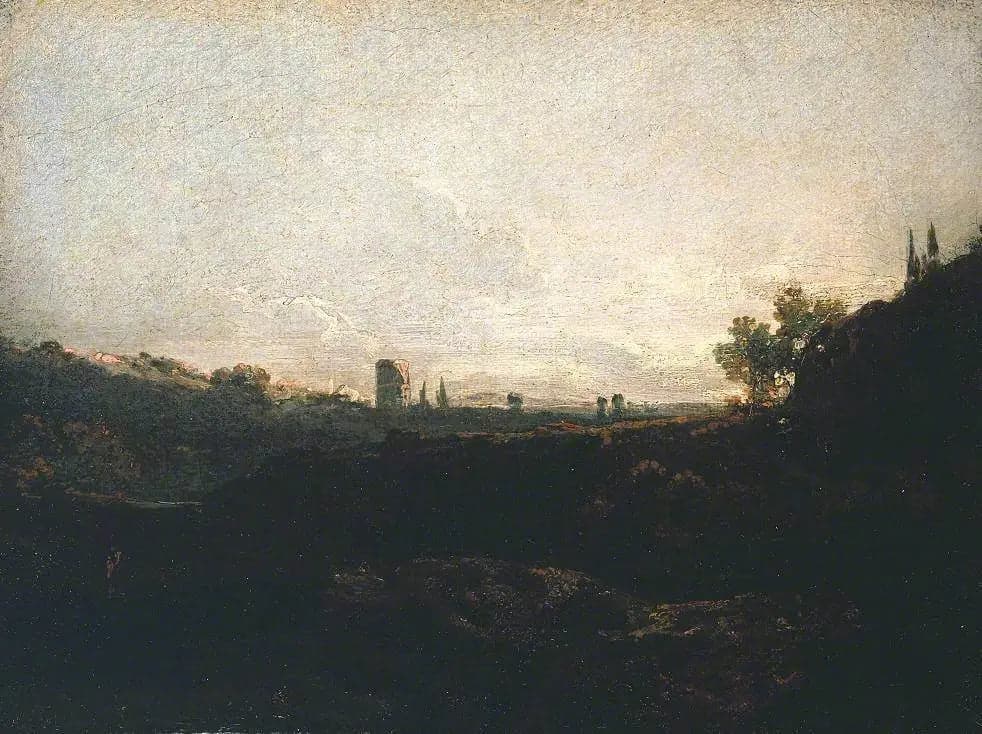
View of a Town
- Original dimensions
- 24.1 x 32.4 cm
- Museum
- Tate
- Year
- 1798
Scene depicted
This painting finely illustrates a panorama of a town, where facades are illuminated by the warm hues of the hearth and where the sky seems to vibrate with colors. The play of shadow and light evokes a striking tranquility, an echo of the everyday masterfully rendered by Turner. The reflections in the water surfaces convey a sense of serenity, painting a living, almost palpable picture.
Historical context
Created in 1798, the iconic painting View of a Town by Joseph Mallord William Turner was born in the emerging romantic context, cradle of emotion and nature. Turner, master of light, captures here an urban scene where structures intertwine harmoniously, a cocoon of vibrant stories. Today, the painting rests in the prestigious collections of the Tate in London, measuring 24.1 by 32.4 cm, a format that serves as a window to another time.
Place in the artist's career
The painting View of a Town takes place at a pivotal moment in Turner’s career, marking the blossoming of his innovative style. At this time, he combines technical virtuosity and personal sensitivity, anchoring his name alongside “The Fighting Temeraire” and “Rain, Steam, and Speed.” These paintings illustrate the evolution of his quest for ethereal light, testifying to a growing artistic maturity.
Anecdote
“Every canvas must tell a story, capture a moment, an emotion. This is how art becomes immortal.” It is with this conviction that Turner wandered through the picturesque alleys of his youth, inspired by the brightness of a spring morning. The painting View of a Town reflects this magic of the everyday, exhaling fragrances of damp earth and fresh air, an invitation to contemplate.