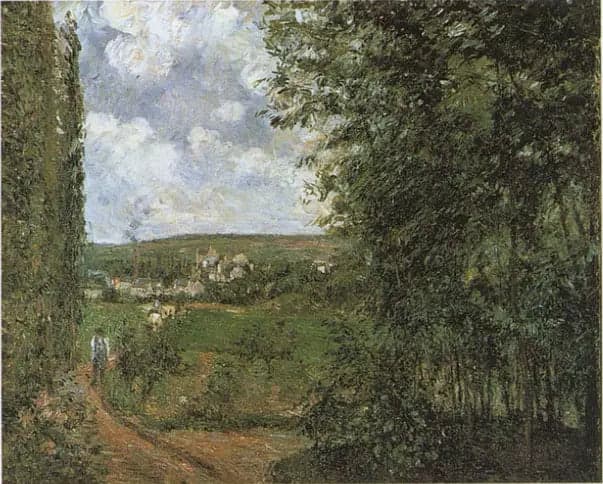
View from the Gratte-Coqs Coast, Pontoise
- Original dimensions
- 56 x 39 cm
- Museum
- Oskar Reinhart Museum "Am Römerholz"
- Year
- 1878
Scene depicted
In “View from the Gratte-Coqs Hill, Pontoise,” Pissarro depicts a lively tableau where impressionists strive to capture light and color. The richly detailed composition invites us to explore a fertile landscape, where fields and water's edges blend harmoniously, creating a peaceful and contemplative atmosphere. This canvas is an ode to nature, celebrating the coexistence of man with his environment.
Historical context
Created in 1878, this painting embodies the essence of Pontoise, a true cradle of impressionism . In this idyllic setting of the Parisian suburbs, Pissarro, a master figure of this movement, immortalizes the serene beauty of nature while integrating humanity into its environment. The canvas is currently housed in the Oskar Reinhart Museum, where it preserves the soul of an era imbued with sensitivity and brightness.
Place in the artist's career
This canvas , at a crossroads in Pissarro's career, marks a phase of neo- impressionism . It positions itself between two other major canvases , “The Potato Harvest” and “Boulevard Montmartre, Spring,” reflecting an evolution in his technique towards more colorful and vibrant compositions, capturing the very essence of the impressionist movement.
Anecdote
“Nature is the best of teachers,” might have said Camille Pissarro during one of his morning walks in Pontoise. It is in moments of calm, where the mist dances on the waters, that this masterpiece came to life. Each brushstroke reveals the thrill of a spring morning, the light melody of a stream caressing the edge of the canvas.