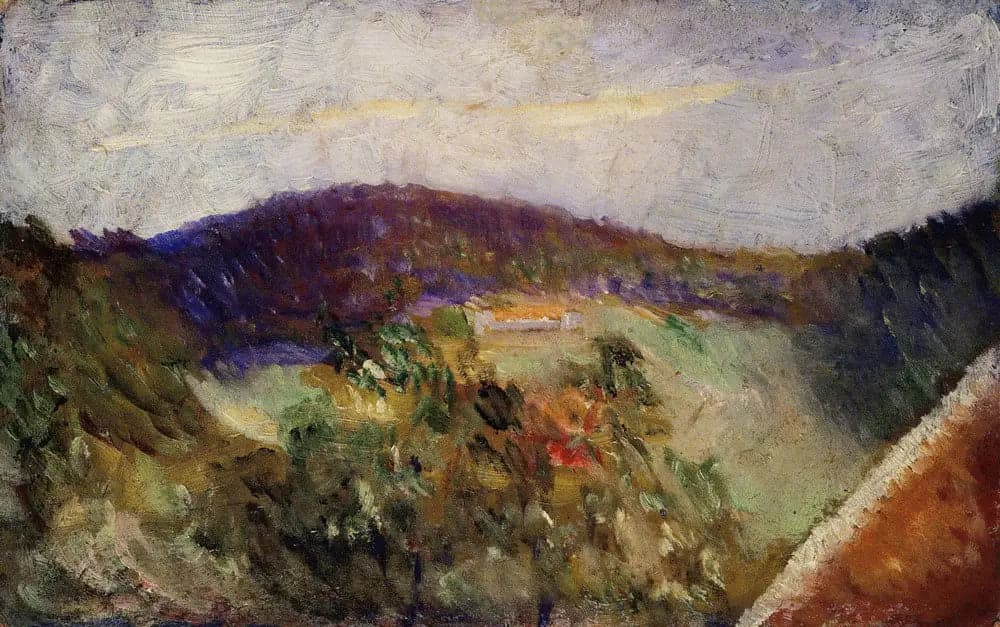
View from Hauketo
- Original dimensions
- 33 x 21 cm
- Museum
- Not specified
- Year
- 1890
Scene depicted
This canvas “View from Hauketo” reveals a nature imbued with the emotional blur that characterizes Munch's art. The lush hills rise gracefully under a nuanced sky, while a tranquil lake reflects the light. This painting evokes an idyllic landscape, a symbol of harmony between man and his environment. The fluid lines tell a silent story, that of a contemplative gaze upon the ephemeral beauty of the world.
Historical context
Created in 1890, this painting immerses the viewer in the Norwegian natural landscape, where Munch, a central figure of symbolism , brilliantly translates the brilliance of striking Scandinavian light. Located in Hauketo, near Oslo, this work belongs to the expressionist movement of which Munch was a pioneer. His canvas reflects a key moment of the 19th century, where art becomes a mirror of the human soul. Although the destination museum remains unknown, its dimensions of 33 x 21 cm make it a composition delicate, ready to invade the space with a touch of authenticity.
Place in the artist's career
“View from Hauketo” represents a key moment in Munch's career, manifesting his technical and emotional development. After creating works like “The Scream” and “The Madonna,” this canvas embodies his artistic maturity, where the quest for sensitivity aligns with a new pictorial language. A palpable evolution emerges between these compositions , revealing the depth of his inner explorations.
Anecdote
“Every moment spent in nature is an emotion lost in the vastness,” said Munch. One spring morning, during a solitary walk, he saw the world in a new light. It was then that the idea for this masterpiece was forged, where each brushstroke responds to the call of the elements, vibrating with an inner life.