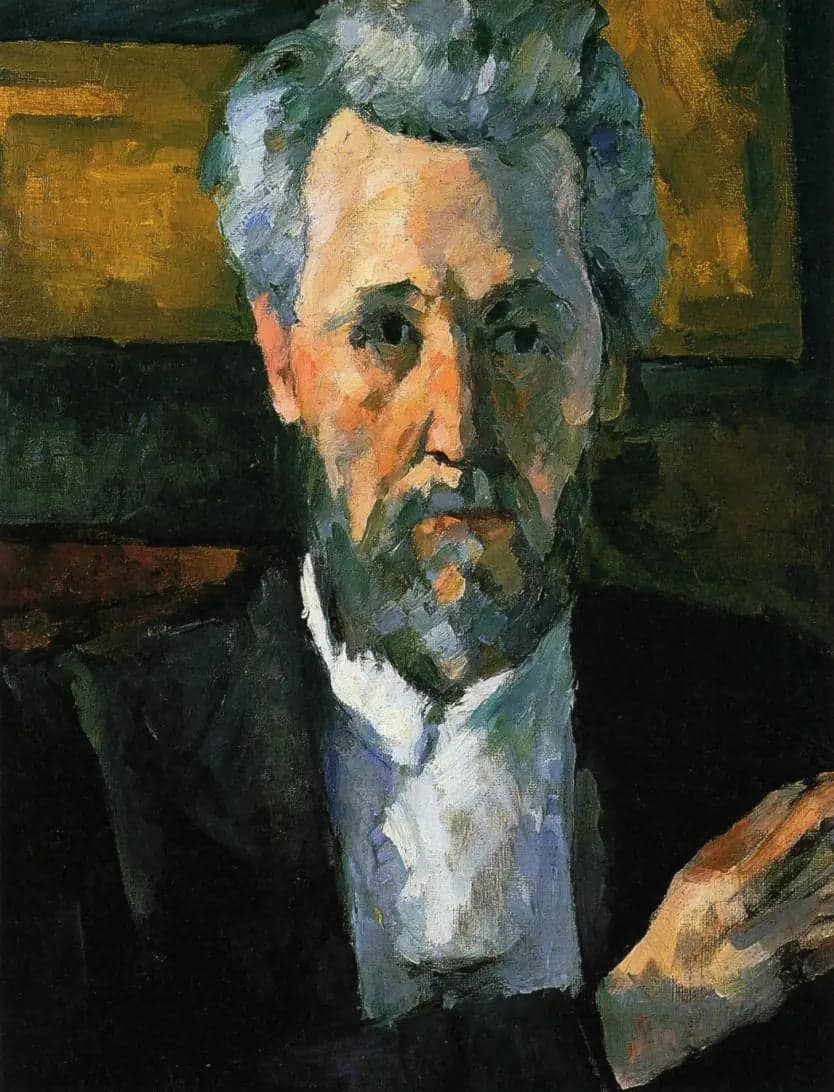
Victor Chocquet
- Original dimensions
- 27.31 x 35.24 cm
- Museum
- Virginia Museum of Fine Arts
- Year
- 1877
Scene depicted
In this pictorial work, Victor Chocquet is depicted with remarkable intensity. The canvas finely captures a fleeting moment, revealing a subtle and contemplative presence. Invitations to introspection effortlessly blend with the faithful representation of his environment, balancing between shadow and light, making the painting a true mirror of Cézanne's creativity.
Historical context
Created in 1877, the painting "Victor Chocquet" stands out for its unique atmosphere, emerging in the heart of Auvers-sur-Oise, a town that has seen the birth of many masterpieces of the Impressionist movement. This painting, emblematic of Cézanne's innovative approach, reflects the evolution of art at a time when light and color began to take on a new dimension. Today, this painting is housed in the Virginia Museum of Fine Arts , radiating with its delicate dimensions.
Place in the artist's career
The painting "Victor Chocquet" positions itself as a pivotal milestone in Cézanne's career, testifying to his ascent towards a more personal and mature style. It can be compared to other masterpieces such as "The Card Players" or "Mont Sainte-Victoire," highlighting his technical and emotional evolution through bolder compositions and vibrant colors.
Anecdote
"Painting is a path of discovery. Each canvas is a dialogue between the gaze and the world that surrounds it." These words resonate as an echo of Cézanne's spirit, hailing from the Provence region, who found inspiration in the beauty of sun-drenched landscapes or in familiar faces encountered during his walks. This initial emotion powerfully reflects in the painting "Victor Chocquet," capturing the essence of this vibrant era.