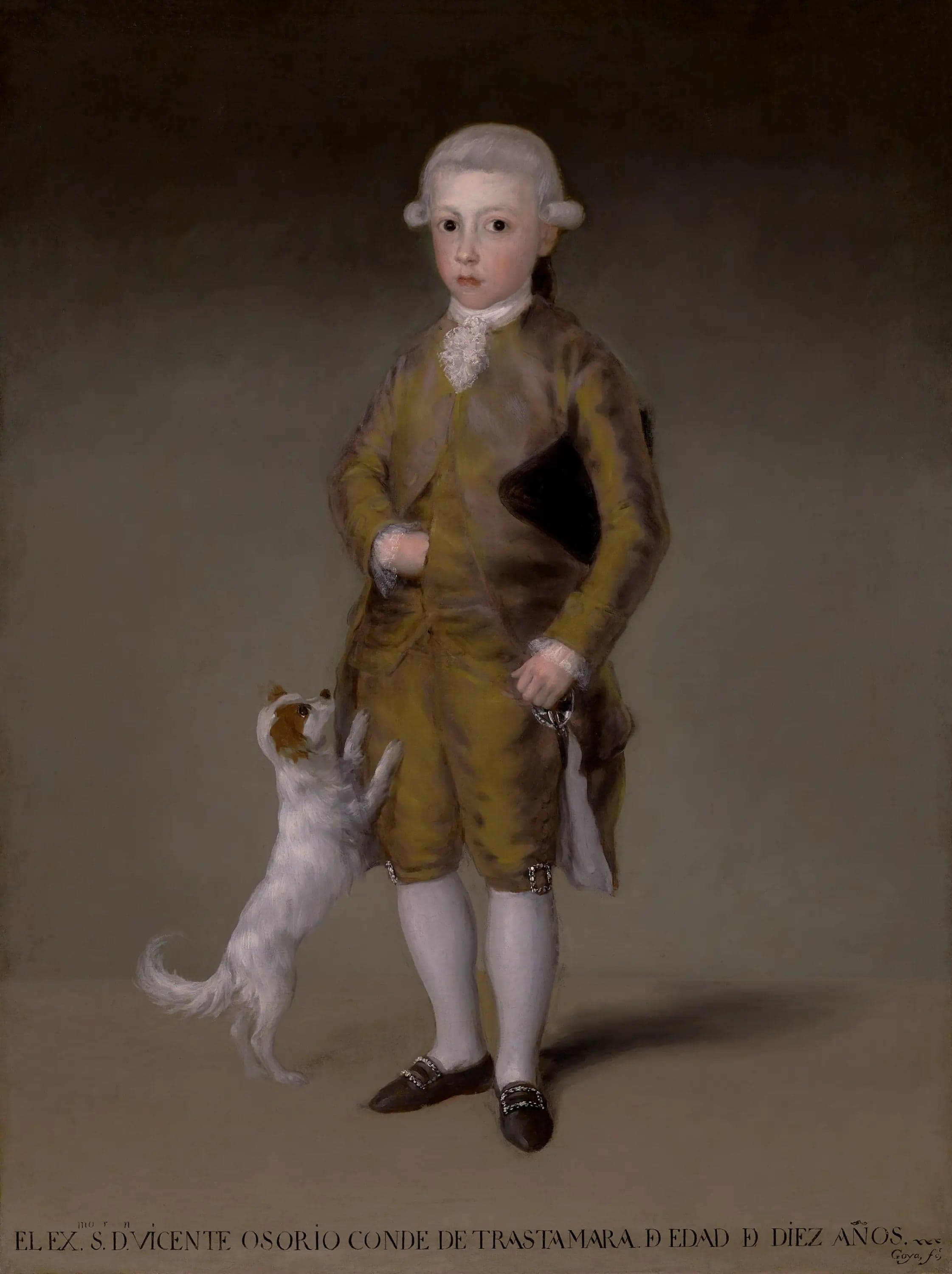
Vicente Osorio de Moscoso, Count of Trastamara
- Original dimensions
- 104.1 x 138.4 cm
- Museum
- Houston Museum of Fine Arts
- Year
- 1786
Scene depicted
This canvas is a striking portrait of a Spanish nobleman, Vicente Osorio de Moscoso, who embodies the character imbued with mystery and grandeur of his time. The work offers a deep insight into human complexity and the role of aristocrats in society, while illustrating Goya's skill in playing with nuances of color and light.
Historical context
Created in 1786, this painting is set in a rich context, at the dawn of the 18th century, in the city of Madrid, Spain. Francisco de Goya , a leading figure of romanticism , highlights themes of nobility and human psychology in a time marked by social and political evolution. The canvas , currently housed in the Houston Museum of Fine Arts, remains an eloquent testimony to this fascinating era of artistic transition.
Place in the artist's career
The creation of this canvas , both delicate and incisive, marks an important milestone in Goya's career. This work, highlighting the psychological subtleties of the subjects, comes just before his most famous works, such as “The Caprices” and “The Naked Maja,” reflecting a turn towards a deeper artistic maturity.
Anecdote
“Light and shadow are the souls of my works,” said Goya. This quote resonates perfectly with the composition of Vicente Osorio de Moscoso, hrabia Trastamara, which captures the essence of Spanish nobility in the rhythm of a golden morning. It is in the alleys of Madrid, cradled by the whispers of furtive conversations, that the artist was inspired to create this masterpiece .