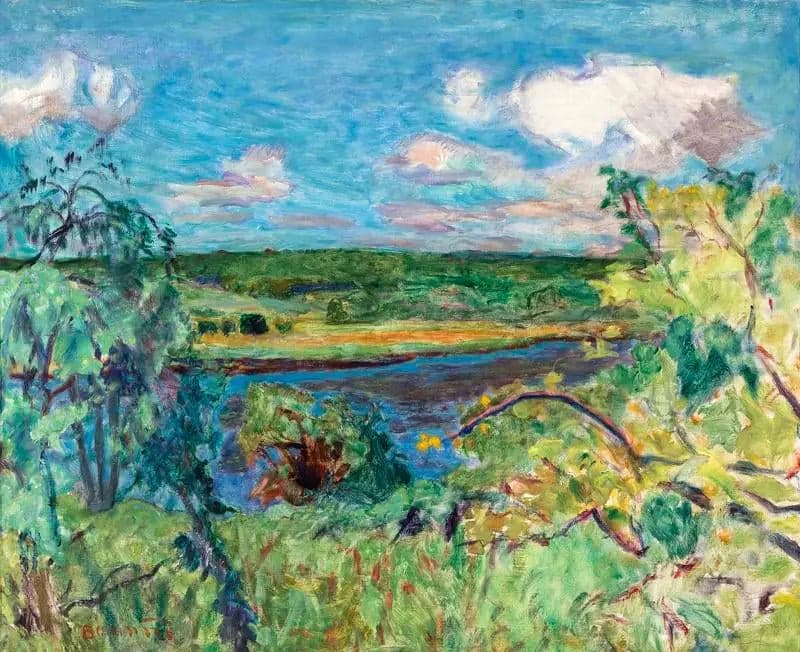
Vernonnet, landscape near Giverny
- Original dimensions
- 63.1 x 50.3 cm
- Museum
- Aberdeen Art Gallery
- Year
- 1924
Scene depicted
The canvas offers an intimate and serene representation of the valley of Vernon, bathed in the shimmering lights of Normandy. Bonnard, with his sharp instinct for color, paints the gentle curve of the hills, the reflections in the river, and the play of shadow and light that makes the leaves of the trees dance. This painting transcends mere representation to become an ode to natural beauty and tranquility.
Historical context
Created in 1924, the painting "Vernonnet, landscape near Giverny" finds its roots in the charming village of Giverny, in Normandy. Pierre Bonnard , an iconic figure of Post-impressionism , captures in this canvas the vibrant essence of French nature, translating his affection for this peaceful region during a time of artistic renewal. Currently exhibited at the Aberdeen Art Gallery , this painting highlights the artist's commitment to light and color.
Place in the artist's career
"Vernonnet, landscape near Giverny" represents a crucial phase in Bonnard's career, illustrating his artistic maturity. Turning from a period of exploration to a stylistic peak, this painting can be paralleled with his earlier works, such as "The Dining Room" and "Bal du moulin de la Galette". Each of them bears witness to his technical evolution, marked by an increasingly bold use of color and light.
Anecdote
“I lose myself in the morning light, every shade tells a story,” said Bonnard while recalling his morning walks. Inspired by a gentle spring morning in Giverny, this masterpiece does not merely represent a landscape; it captures a breath of life, an intimate connection between the artist and his environment.