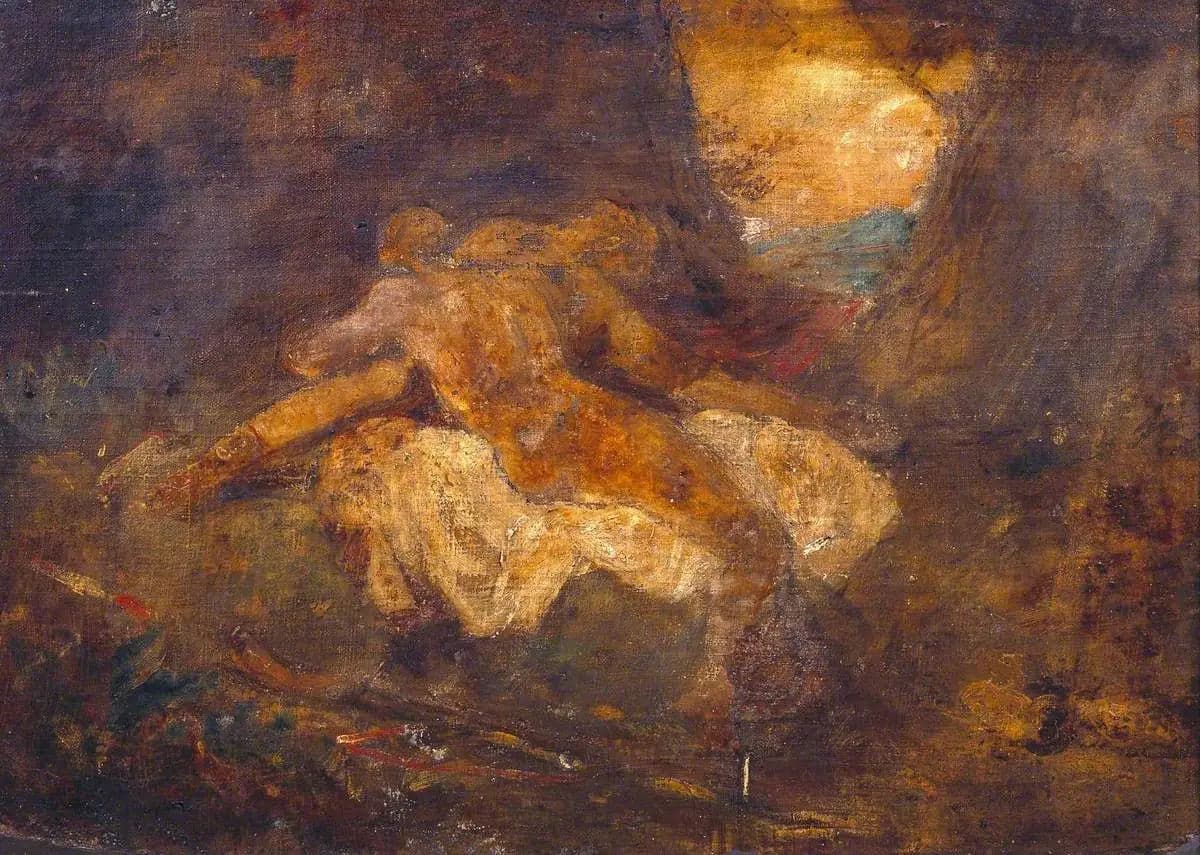
Venus et le Mort Adonis
- Original dimensions
- 31.8 x 45.1 cm
- Museum
- Tate
- Year
- 1805
Scene depicted
This canvas depicts a poignant scene from the classical myth, where the goddess Venus mourns the death of her lover Adonis, a moment frozen in time, imbued with feeling and melancholy. The bodies intertwine in a composition charged with emotion, revealing a tension between life and death, passion and loss.
Historical context
Created in 1805, in the vibrant city of London, this painting is part of the Romantic period, where emotion and nature prevail. Venus and the Dead Adonis evokes a time when pictorial emotion was at the heart of artistic concerns. Currently, this canvas is preserved at the Tate , a sanctuary of art in London, testifying to the richness of British cultural heritage.
Place in the artist's career
In Turner’s career, Venus and the Dead Adonis represents a pivotal step, amalgamating his Romantic style and the beginnings of his quest for light. In parallel, other canvases like The Fighting Temeraire and Rain, Steam and Speed show his evolution towards abstraction, fascinating the viewer with his technical and emotional mastery.
Anecdote
“In the whisper of tears lie the colors of passion,” one day, J. M. W. Turner is said to have shared with a friend, inspired by observing the tears of nature at dawn. This reflection of emotion resonates in this canvas , where Venus, heartbroken, leans over Adonis, capturing the very essence of tragedy.