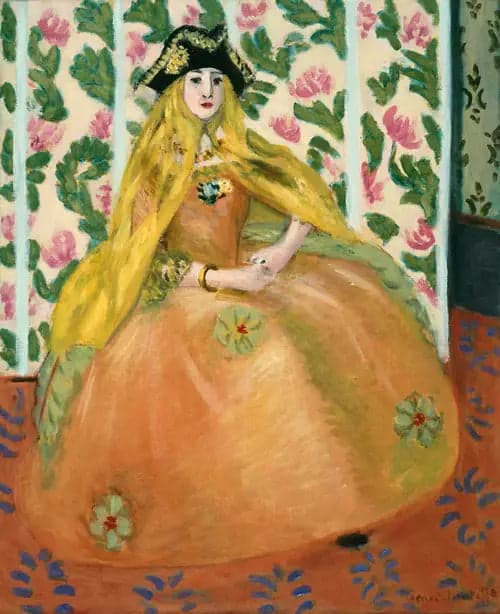
Venetian
- Original dimensions
- 50.8 x 61.9 cm
- Museum
- Memorial Art Gallery
- Year
- 1923
Scene depicted
"Vénitienne" captures the essence of a woman of unique grace. Her portrait, enveloped in golden light, embodies the beauty of Venetian landscapes and characters. Matisse was able to transform the ordinary into the extraordinary, using each brushstroke to celebrate feminism, sensuality, and the sweetness of enjoying the little things in life, like a sweet fragrance floating in the air.
Historical context
Created in 1923, the painting "Vénitienne" testifies to the genius of Henri Matisse , a pillar of Fauvism , an artistic movement that revolutionized the aesthetics of its time. It is in a vibrant and creatively bubbling context in the city of Nice, France, that this canvas was born, capturing the very essence of Mediterranean beauty. Today, this magnificent painting is preserved at the Memorial Art Gallery , where it continues to dazzle visitors with its elegant dimensions of 50.8 x 61.9 cm.
Place in the artist's career
This painting , from Matisse's mature period, perfectly illustrates his stylistic evolution. It stands alongside other masterpieces such as "The Dance" and "The Joy of Life," demonstrating his boldness in exploring color and form while revealing deep emotions. It is a key step in affirming his bold style, at the crossroads between the traditional and the modern.
Anecdote
Henri Matisse once said: "Color is the key, light and air are its musical notes." It was while strolling through the sunlit alleys of Nice on a spring morning flooded with light that he encountered the inspiration that whispered the idea for this pictorial work . The face of the woman, with her serene expression and natural elegance, represents a visual melody, a harmony between color and light, evoking the warm warmth of the Côte d'Azur.