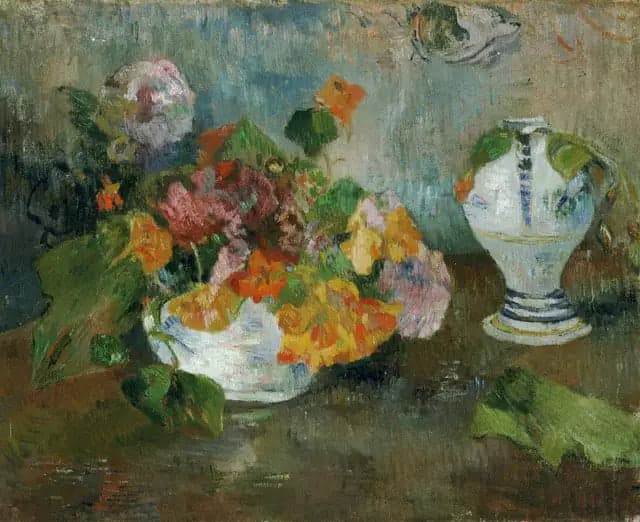
Vase with Nasturtiums and Quimper Faience
- Original dimensions
- 41.1 x 33.2 cm
- Museum
- Musée des beaux-arts du Canada
- Year
- 1886
Scene depicted
Within this canvas , Gauguin immerses us in a universe where nature meets local craftsmanship. A vase filled with nasturtiums, these delicate flowers bursting with warm colors, stands majestically amidst a Quimper faïence, symbolizing the harmony between the artwork and its environment. The whole, like a tribute to Breton beauty, invites silent contemplation.
Historical context
Created in 1886, in the heart of the post-impressionist era, this painting emblematic of Paul Gauguin emerges in Pont-Aven, a small Breton town that becomes the cradle of a unique artistic movement. This canvas , currently preserved at the Musée des beaux-arts du Canada , captures a natural and colorful essence under an innovative gaze.
Place in the artist's career
This painting occupies a significant place in Gauguin's artistic journey, marking the beginning of a bold stylistic exploration. Alongside works such as “Les Halles de Papeete” and “La vision du sermon,” one notes here a quest for color and form that announces his pursuit of simplification and pure emotion.
Anecdote
“Painting is a quest for truth in light.” These words resonate like an echo of the inspiration that guided Gauguin during the creation of his masterpiece . Imagine a sunny morning in Brittany, where every color of nature seems to vibrate and invite to dream, leading Gauguin to immortalize this moment through his canvas.