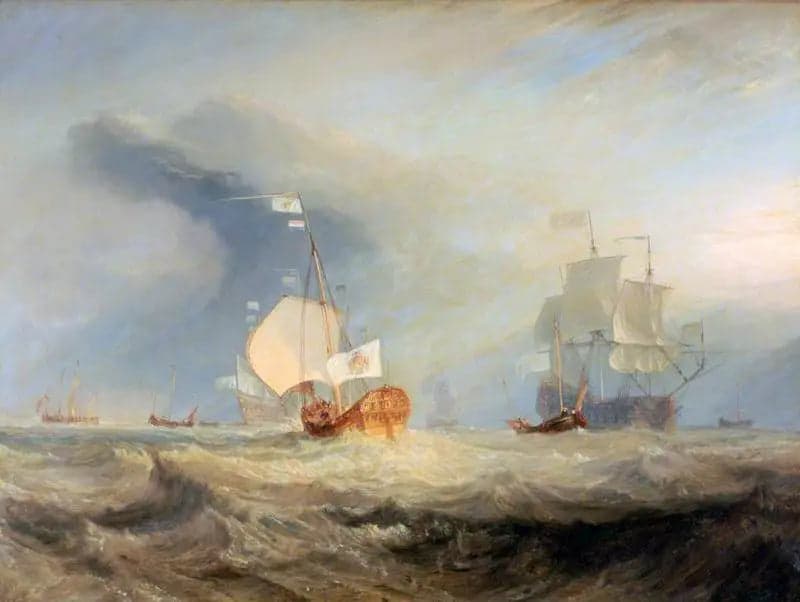
Van Tromp's Barge Entering the Texel, 1645
- Original dimensions
- 121.9 x 90.2 cm
- Museum
- Sir John Soane's Museum
- Year
- 1831
Scene depicted
In this painting , we witness the majestic entry of a merchant vessel leading Vice Admiral Van Tromp, a key figure in the Dutch navy. The painting evokes not only the naval power of the Netherlands but also a moment of peace and harmony between man and the ocean, symbolizing a flourishing nationalism.
Historical context
Created in 1831, this painting is emblematic of the historical and maritime context of the 17th century, specifically near the port of Texel, in the Netherlands. It is part of the romantic movement, reflecting a time when the sea symbolized both beauty and danger. Currently, this canvas is carefully preserved at the Sir John Soane’s Museum in London, captivating generations of admirers.
Place in the artist's career
This canvas marks a turning point in Turner’s career, illustrating his artistic maturity. Alongside other masterpieces such as “The Last Voyage of the Temeraire” and “Rain, Steam and Speed,” we can observe his evolution towards increasingly experimental compositions, where light and atmosphere dominate the structure.
Anecdote
“The mute symphony of the waves and the brilliance of the sky were my inspiration,” Turner might have confided about this work. Imagine a fresh morning, bathed in pastel light, as the sound of sails rustles and the salty air fills the atmosphere; it is this magical setting that nourished the artist's creativity and gave his canvas a vibrant energy.