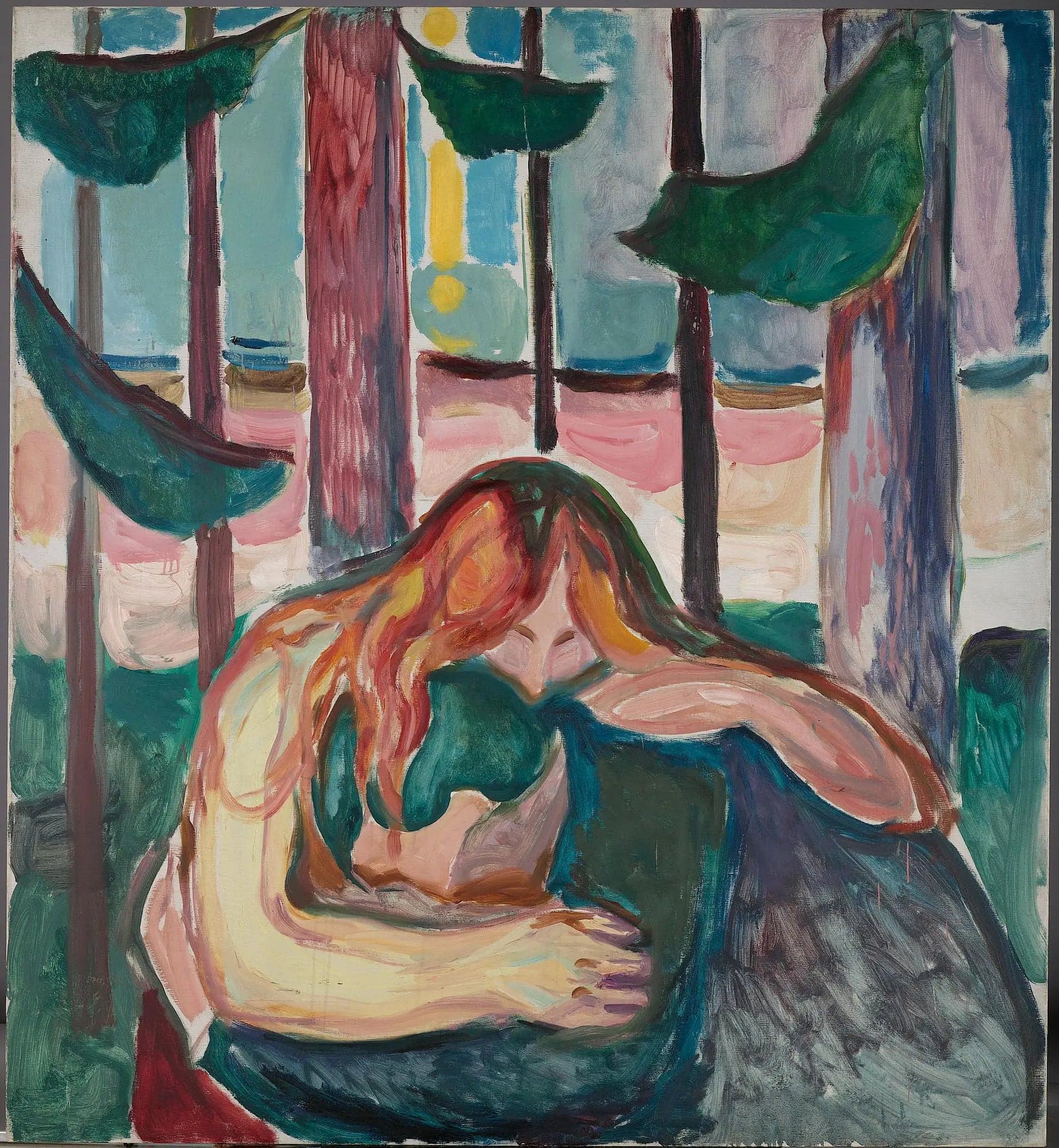
Vampire in the Forest
- Original dimensions
- 137 x 149 cm
- Museum
- Munch Museum
- Year
- 1916
Scene depicted
In this painting , the viewer is immersed in a forest landscape imbued with mystery and sensuality. The central figure, evoking a vampire, is surrounded by a nature that is both magnetic and oppressive. The dark and saturated colors blend harmoniously to capture the struggle between desire and fear, inviting everyone to reflect on tumultuous passions and complex human relationships.
Historical context
Created in the heart of Norway, in the city of Oslo, this iconic work from 1916 belongs to the expressionist movement. Influenced by the emotional upheavals of a time grappling with profound questions, the painting immerses us in a universe where human psychology is revealed through bold shapes and colors. The canvas is currently on display at the Munch Museum, where it is carefully preserved for art lovers from around the world to admire.
Place in the artist's career
Vampire in the forest stands as a centerpiece of Munch's work, illustrating his stylistic and emotional evolution. Compared to other significant achievements such as The Scream and The Madonna , this canvas reveals artistic maturity while continuing to explore themes of solitude and anxiety, characteristic of his journey.
Anecdote
Edvard Munch , speaking of his painting , said: "My art is a cry of the soul, a struggle between the real and the imaginary." The inspiration for Vampire in the forest came to him one misty morning as he walked through the woods, enveloped by the melancholy and mystery of the forest. This fleeting moment gave birth to a pictorial work full of emotional tension and energy.