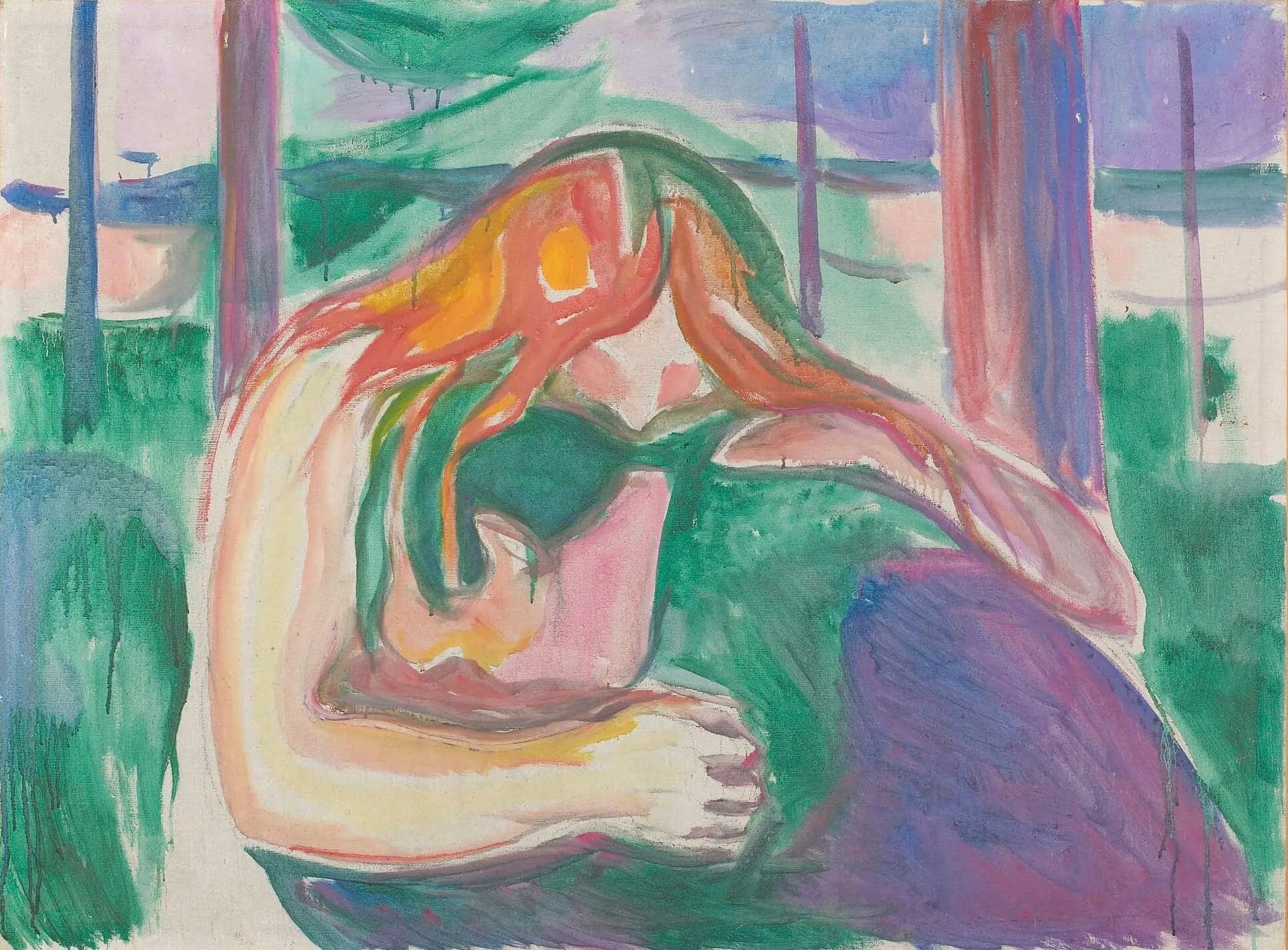
Vampire
- Original dimensions
- 110 x 85 cm
- Museum
- Not specified
- Year
- 1917
Scene depicted
In this painting, Munch depicts a man, intriguingly staged, leaning over a woman with an unidentifiable face, symbolizing romantic passion, but also pain and suffering. The kisses depicted evoke raw and visceral emotions that traverse the viewer, creating an atmosphere that is both enchanting and disturbing. This pictorial work invites a journey into the unknown of feelings.
Historical context
Created in 1917, during the height of the expressionist movement, this iconic work comes to life in a geographical context deeply rooted in Norwegian culture, where Edvard Munch drew his inspiration. At that time, the artist navigates both the murky waters of his own emotions and the intense wake of urban life. Although the painting is currently not displayed in a specific museum, it embodies an exploration of human passions. With impressive dimensions of 110 x 85 cm, this canvas irresistibly attracts the eye and the soul.
Place in the artist's career
"Vampire" represents a peak in Edvard Munch's career, marking a period of maturity where his themes of love, death, and melancholy are revealed with increased intensity. While other paintings such as "The Scream" and "The Madonna" also explore these themes, "Vampire" emerges as a powerful synthesis of his artistic concerns, a canvas that is both personal and universal.
Anecdote
It is said that on a misty morning, Edvard Munch observed the dance of two lovers, a bright and vibrant setting, which triggered the creation of this painting . His perceived view of human relationships, imbued with tragedy and desire, led him to say: "Love is like a vampire that sucks your blood, and I want to paint this essence." Thus, the painting "Vampire" becomes the echo of his deepest thoughts, revealing the complexity of human relationships.