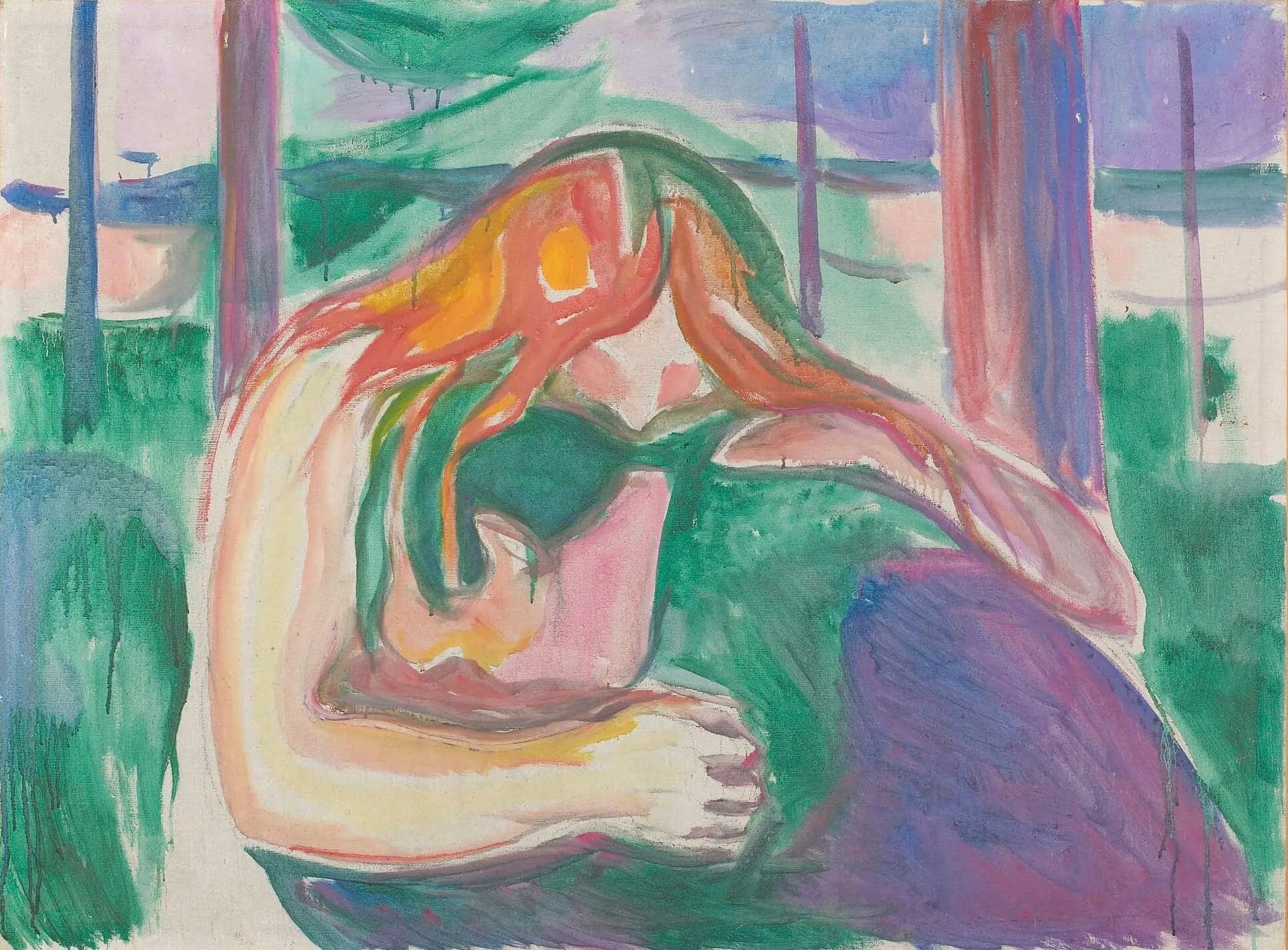
Vampire
- Original dimensions
- 104 x 84 cm
- Museum
- Munch Museum
- Year
- 1916
Scene depicted
The painting “Vampire” unveils a poignant scene where a woman, with an enchanting gaze, embraces a man in a troubling atmosphere. The palpable tension emanating from this composition testifies to the inner struggles and human emotions. Munch captures, with rare intensity, the duality of love and pain, creating a portrait that is both magnificent and tragic.
Historical context
Created in 1916 in Oslo, this painting is emblematic of the expressionist movement, an artistic current dear to Edvard Munch . It is in a trembling Norway, between shadows and lights, that this painting found its inspiration. Currently preserved at the Munch Museum in Oslo, this masterpiece blends subtlety and power. Its dimensions, 104 x 84 cm, sublimely established, enhance its presence on the wall where it is located.
Place in the artist's career
“Vampire” represents a decisive step in Munch's career, illustrating his transition from a promising beginning to a pronounced artistic maturity. Through two other works—“The Scream” and “The Madonna”—we observe a significant technical evolution, where Munch experiments with new depths of expression, making each painting a mirror of his soul.
Anecdote
“Love consumes me, and this moment evokes a vampire wandering in the night,” Munch is said to have once remarked, inspired by a glance exchanged under a twilight sky. This moment suspended in time permeates the canvas , revealing the torments and passions of a creative soul.