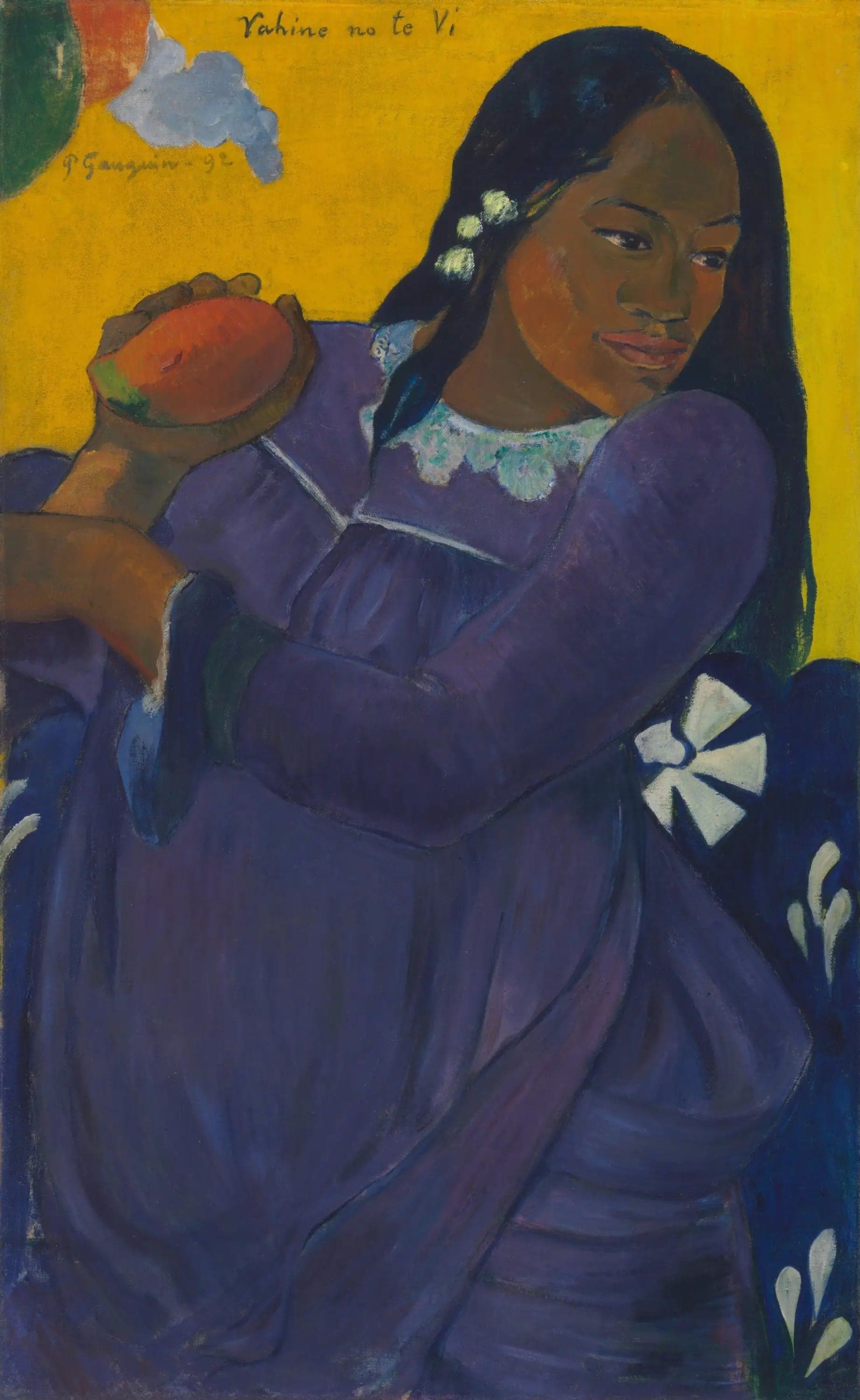
Vahine Don't Live for You
- Original dimensions
- 45.1 x 73 cm
- Movement
- post impressionism
- Museum
- Baltimore Museum of Art
- Year
- 1892
Scene depicted
The painting "Vahine ne te vis pas" immerses us in a vibrant universe where a Tahitian woman, delicately draped, seems to lead an introspective life in the heart of lush nature. The sinuous forms of the body and the soothing tension of the colors evoke a tumult of feelings, between mystery and serenity. The palm trees and the surrounding scene form a setting where the woman wanders in an inner world, allowing us to glimpse a reflection of her soul.
Historical context
Created in 1892 in Tahiti, the painting "Vahine ne te vis pas" is part of the little-known but fascinating period of post impressionism . This canvas , currently exhibited at the Baltimore Museum of Art , evokes tropical atmospheres where color and light intertwine to bring to life a scene of poignant beauty. Measuring 45.1 x 73 cm, this painting is not only a testament to a moment in art history but also a window into the exoticism of the Pacific islands.
Place in the artist's career
"Vahine ne te vis pas" stands as a key work in the career of Paul Gauguin , marking a period of transformation and stylistic hemisphere. It fits into an artistic continuum ranging from his early impressionist compositions to his bolder creations. Alongside "The Yellow Christ" and "Vision After the Sermon," this painting reflects his technical and emotional evolution, where the painting becomes a symphony of colors and forms.
Anecdote
"Color is my language, light is my song." These words from Gauguin evoke his love for the tropical light that seems to dance on the painting like a gentle summer breeze. Inspired by the wild beauty of Tahiti, the artist captured in "Vahine ne te vis pas" the essence of a meeting between culture and nature. These precious moments, isolated in time, imbue each brushstroke of the pictorial work.