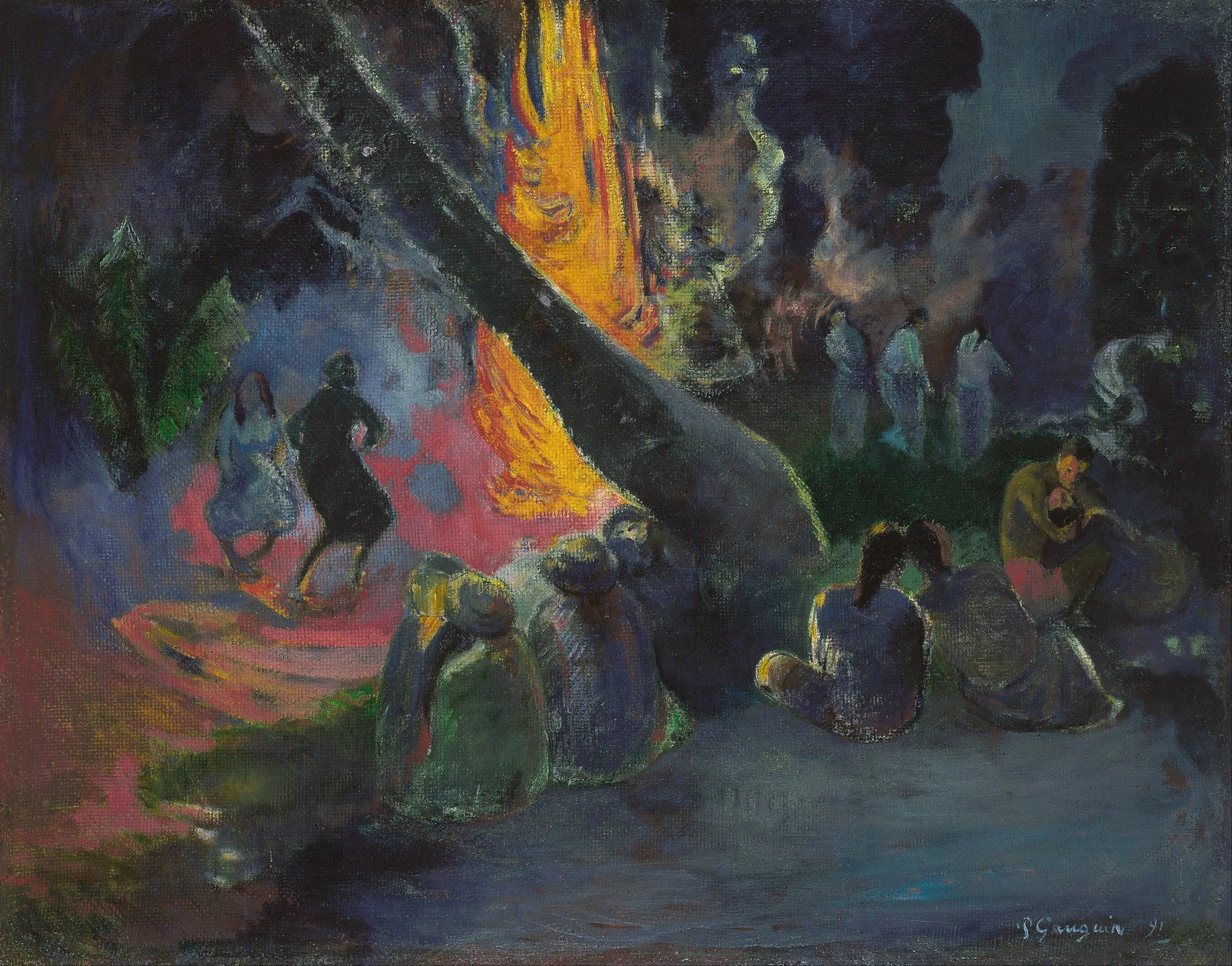
Upa upa, The Dance of Fire
- Original dimensions
- 92.3 x 72.6 cm
- Museum
- Israel Museum
- Year
- 1891
Scene depicted
This pictorial work celebrates a moment of communion between man and the sacred fire, where bodies dance in harmony, illuminated by vibrant flames. The characters, draped in warm colors, seem to rise in palpable spirituality, encapsulating the very essence of their culture. The painting tells a story much larger than a simple dance: it evokes the spirit of life, passion, and mystery.
Historical context
Created in 1891 during his stay in Polynesia, the painting Upa upa, La Danse de feu is at the heart of the post-impressionist movement. Gauguin, with this canvas , aims to capture not only a scene but the soul vibrating under the starry sky of Tahiti. Currently exhibited at the Israel Museum , this painting testifies to a time when the artist sought to break away from conventions to embrace the purity of a natural world.
Place in the artist's career
Upa upa, La Danse de feu stands out as a high point in Gauguin's artistic evolution. After works like Vision after the sermon and The Yellow Christ, this painting shows stylistic and emotional maturity. With increased expressiveness, it shifts from a calm realism to a bold projection of the soul.
Anecdote
“I wanted to ignite the canvas with my memories, to make the color dance that expressed itself within me.” One spring day in Tahiti, surrounded by the sounds of drums and the softness of sea breezes, Gauguin saw this masterpiece come to life. Each brushstroke on the canvas becomes a testament to a burning passion.